
How Consumer Electronics Brands Can Build Dealer Incentive Programmes That Drive Genuine Sell-Out

Sign up for our newsletter for trending top content!
Introduction
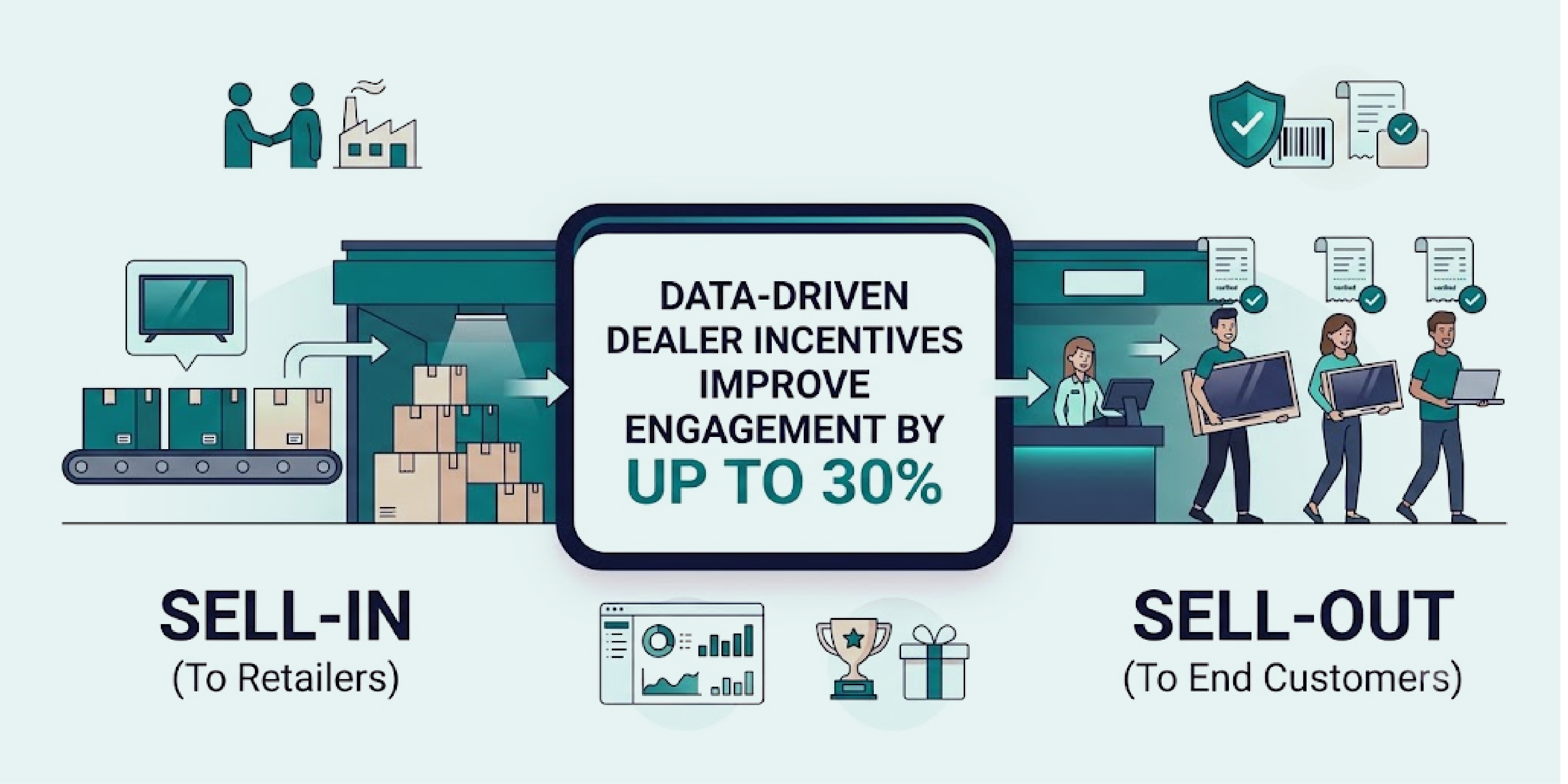
McKinsey research shows that companies with highly engaged channel ecosystems consistently outperform peers on growth and profitability. Yet many consumer electronics brands still reward distributors and dealers based primarily on inventory movement rather than verified customer purchases.
That approach creates a costly disconnect. Products move into retail channels, but brands often struggle to influence what sales staff recommend, which premium SKUs get promoted, and whether strategic products actually reach end customers. For Sales Leaders, sell-in metrics provide only partial visibility. Genuine market success depends on sell-out.
This article explores how consumer electronics brands can design dealer incentive programmes that encourage recommendation behaviour, increase premium product penetration, improve sell-out verification, and maintain sustained dealer engagement. It also examines the systems and data capabilities needed to create scalable incentive ecosystems that drive measurable revenue outcomes.
Why Consumer Electronics Dealer Incentives Reward Stock Movement but Not Actual Sell-Out
Traditional dealer incentive structures often reward procurement behaviour rather than customer acquisition behaviour.
Many brands provide rebates, volume incentives, or quarterly targets based on purchases from distributors. While these mechanisms help move inventory into the channel, they do not necessarily influence consumer demand.
According to Gartner, organisations increasingly recognise that outcome-based incentive design creates stronger behavioural alignment than activity-based rewards. In consumer electronics, rewarding sell-in alone encourages channel loading rather than sustainable market growth.
The sell-in versus sell-out gap
Dealer owners frequently purchase products based on discount opportunities or incentive thresholds. Counter staff, however, influence what consumers ultimately buy.
This creates three challenges:
- Dealers prioritise inventory accumulation.
- Counter staff recommend products with higher immediate benefits.
- Brands lose visibility into actual end-customer demand.
McKinsey research highlights that data transparency and behavioural incentives significantly improve channel performance when linked to measurable outcomes.
Consumer electronics categories face additional complexity because replacement cycles continue to shorten. Customers compare specifications, financing options, warranty benefits, and service quality before making decisions.
Dealer incentive programmes therefore need to reward:
- Verified customer purchases.
- Premium product recommendations.
- Product activations.
- Warranty registrations.
- Repeat sales performance.
Brands that connect incentives to verified sell-out metrics gain more accurate forecasting capabilities and stronger demand planning processes. Deloitte notes that organisations using data-driven channel management approaches achieve better commercial effectiveness and resource allocation.
The objective is not simply moving stock. It is influencing buying decisions at the point of purchase.
Premium SKU Push: How to Design Incentives That Drive Dealers to Recommend Your High-Margin Products
Premium products typically generate higher margins, yet dealers do not always prioritise them during customer conversations.
Forrester research suggests that frontline engagement has a measurable influence on purchase outcomes, particularly in categories where consumers seek advice before buying. Consumer electronics remains one of those categories.
If brands want dealers to actively recommend premium devices, incentive structures need to reward behaviour beyond unit sales.
Incentivise strategic outcomes
Instead of rewarding all products equally, Sales Leaders can assign differentiated values based on commercial priorities.
Examples include:
- Higher rewards for premium models.
- Additional incentives for accessory attachment rates.
- Bonuses for extended warranty conversion.
- Campaign accelerators for new product launches.
Aberdeen Group research indicates that organisations aligning incentives with strategic business goals experience stronger sales performance than those using flat reward models.
Behavioural science also supports this approach. Incentive programmes become more effective when participants understand precisely what actions lead to greater rewards.
This is where structured channel incentive platforms become valuable.
Solutions such as Paytives enable brands to configure targeted campaigns, assign varying incentive values, create leaderboard experiences, and reward dealers based on premium product performance. Rather than applying blanket schemes across all categories, Sales Leaders can shape dealer behaviour around margin improvement objectives.
Explore: https://www.therewardstore.com/paytives/
Dealer Owner Incentives vs Counter-Staff Incentives: When Each Lever Works
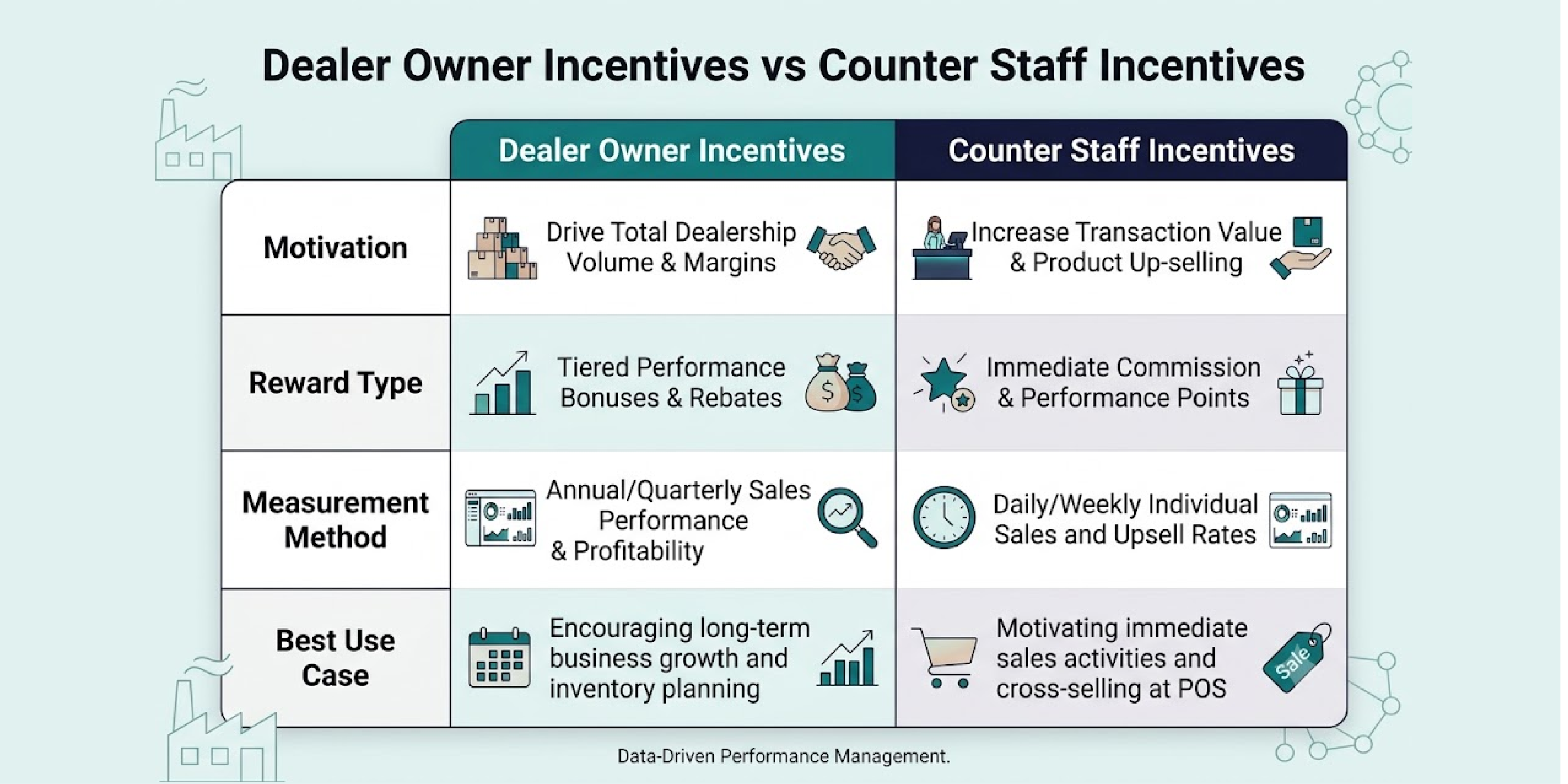
Not every participant within the retail ecosystem influences purchase decisions in the same way.
Dealer owners focus on profitability, inventory turnover, and cash flow management. Counter staff focus on recommendations, product demonstrations, and customer conversion.
Gallup research consistently shows that recognition linked directly to individual contribution improves motivation and engagement. Applying that principle to consumer electronics channels requires a segmented incentive strategy.
Decision framework for incentive design
When dealer owner incentives work best
Dealer owner incentives suit initiatives involving:
- Stock commitments.
- Strategic category expansion.
- Market development.
- Multi-store growth objectives.
- Seasonal volume targets.
When counter-staff incentives perform better
Counter-staff rewards often deliver stronger outcomes when brands need to influence recommendation behaviour.
Examples include:
- Premium television upgrades.
- High-end appliance adoption.
- Smart home ecosystem sales.
- Product bundles.
- Extended warranty attachment.
According to Incentive Research Foundation studies, immediate recognition frequently produces stronger behavioural reinforcement than delayed annual rewards.
Consumer electronics brands that combine owner-level incentives with frontline recognition programmes typically achieve better balance between inventory movement and end-customer conversion.
The most effective models acknowledge that dealers buy products, but sales associates often determine what consumers purchase.
Warranty Registration as an Incentive Trigger: Solving the Sell-Out Verification Problem
One of the largest challenges in dealer incentive management involves verification.
Brands need confidence that rewarded transactions reflect actual customer purchases rather than stock transfers.
Warranty registration provides an effective mechanism for validating sell-out.
Bain & Company research highlights the importance of first-party customer data in building stronger customer relationships and improving commercial decision-making. Warranty activation generates exactly that opportunity.
Why warranty registration matters
Warranty registration captures:
- Customer identity.
- Purchase date.
- Product serial number.
- Dealer information.
- Geographic demand trends.
This data creates a reliable sell-out verification framework.
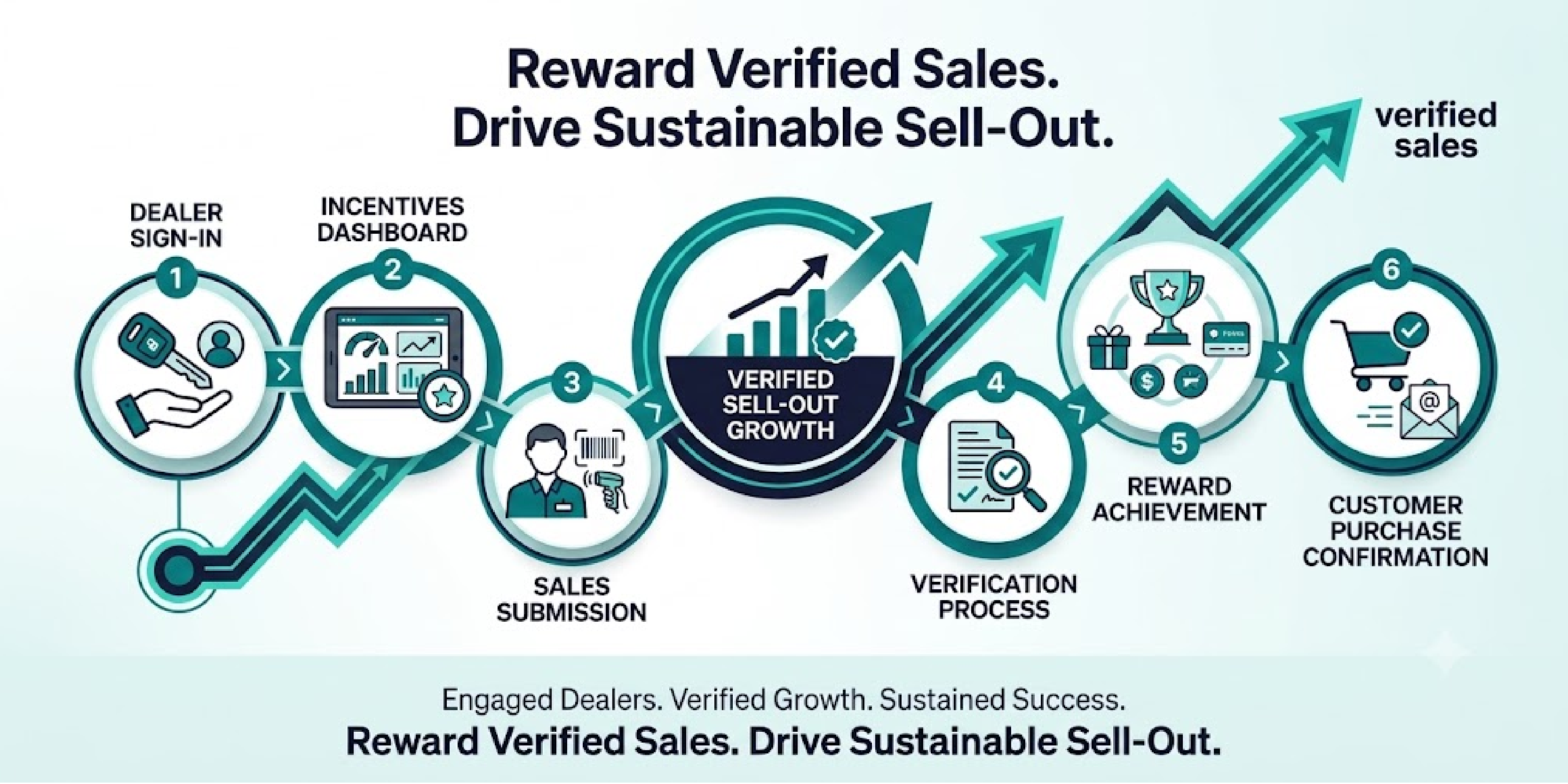
Instead of rewarding dealers for invoices alone, brands can tie incentives to confirmed product activations.
Benefits include:
- Reduced fraud risk.
- Better market intelligence.
- Improved forecasting accuracy.
- Enhanced customer lifecycle engagement.
- Increased service opportunities.
Many Sales Leaders also use warranty-triggered incentives to strengthen customer retention initiatives.
For example, customers who register products can receive onboarding communications, service reminders, and loyalty campaigns.
Dealer participants receive recognition only after activation validation occurs.
Platforms designed for channel incentives simplify this process significantly. Paytives allows organisations to connect incentive logic with verified sales events, automate qualification rules, and provide real-time visibility into incentive status.
According to Deloitte, organisations that build stronger data ecosystems improve decision quality, operational efficiency, and commercial responsiveness. Warranty-linked incentives support all three objectives.
Sell-out verification ultimately transforms incentive programmes from assumptions into measurable commercial engines.
How to Run Launch SPIFFs Without Destroying Steady-State Dealer Motivation
Short-term launch incentives generate excitement, but poorly structured campaigns can damage long-term engagement.
Sales teams often observe a recurring pattern.
Dealer participation spikes during product launches, declines immediately afterwards, then remains inactive until the next campaign begins.
Gallup research shows that sustained recognition creates stronger engagement outcomes than sporadic reward cycles. Consumer electronics brands therefore need balanced incentive architectures.
Build layered motivation models
An effective structure combines:
Always-on rewards
These maintain baseline participation.
Examples include:
- Monthly sell-out incentives.
- Tier progression.
- Achievement badges.
- Leaderboards.
- Continuous recognition.
Campaign-based accelerators
These drive temporary focus.
Examples include:
- New product launch bonuses.
- Double reward periods.
- Category contests.
- Regional challenges.
- Limited-time premium incentives.
Avoid common mistakes
Brands frequently undermine programme credibility by:
- Changing rules mid-campaign.
- Offering inconsistent rewards.
- Introducing excessive complexity.
- Delaying payouts.
- Running too many promotions simultaneously.
According to Mercer research, employees and channel participants respond more positively to programmes that maintain consistency and transparency.
Sales Leaders should communicate launch SPIFFs as accelerators rather than replacements for existing incentive frameworks.
This approach ensures dealers remain motivated even when no major product introductions occur.
Structured incentive platforms support this model effectively by allowing brands to create overlapping campaigns, segment audiences, automate qualification logic, and deliver rewards rapidly without increasing administrative burden.
For consumer electronics organisations operating across multiple regions, sustained engagement often matters more than short-lived campaign spikes.
Real-Time Sell-Out Dashboards: What Data Transparency Does to Dealer Engagement
Visibility changes behaviour.
When dealers understand where they stand, how close they are to targets, and what rewards they can unlock next, participation increases.
The Incentive Research Foundation has found that transparent goal tracking improves engagement and achievement levels across incentive programmes.
Consumer electronics channels generate enormous volumes of data. Yet many dealers still receive performance updates monthly or quarterly.
By then, motivation opportunities have already disappeared.
What high-performing dashboards include
Effective dealer dashboards provide:
- Sell-out performance metrics.
- Target attainment tracking.
- Ranking visibility.
- Pending rewards status.
- Campaign participation rates.
- Product category performance.
- Territory comparisons.
McKinsey research suggests that organisations embracing real-time decision making respond faster to market shifts and outperform slower competitors.
Transparency also strengthens trust.
Dealers are more likely to participate when they can independently verify progress and understand incentive calculations.
Paytives enables brands to provide real-time dashboards through branded dealer portals, allowing participants to track achievements, monitor rankings, and view earned rewards instantly.
For Sales Leaders, dashboards deliver additional value.
They provide immediate insight into:
- Which regions underperform.
- Which products require promotional support.
- Which dealer segments deserve additional investment.
- Which campaigns generate the strongest return.
The future of channel incentives lies not in annual statements or spreadsheet reports. It lies in continuous visibility that transforms incentives into an ongoing engagement experience.
Frequently Asked Questions
What is a consumer electronics dealer incentive programme focused on sell-out?
A sell-out incentive programme rewards dealers, retail staff, or channel partners based on verified customer purchases rather than inventory purchases. The objective is to influence recommendation behaviour and improve actual market demand. These programmes often use activations, registrations, or validated transactions as performance triggers.
How can brands verify dealer sell-out accurately?
Warranty registrations remain one of the most reliable verification mechanisms. They connect products, customers, and dealers through a single transaction record. Brands can also integrate activation data, retailer systems, or CRM platforms to strengthen validation processes.
Why do premium SKU incentives perform better than flat incentive models?
Premium incentives direct attention towards products with higher margins or strategic importance. Aberdeen Group research indicates that incentives aligned with business priorities produce stronger commercial outcomes. They also encourage sales teams to focus on value rather than volume alone.
When should brands use counter-staff incentives instead of dealer owner incentives?
Counter-staff incentives work best when recommendation behaviour influences purchasing decisions. Dealer owner incentives perform better when brands seek inventory commitments, category expansion, or regional growth. Many successful programmes combine both approaches to maximise impact.
Can Paytives support global consumer electronics incentive programmes?
Yes. Paytives supports multi-tier incentive structures, automated calculations, real-time dashboards, global payouts, and multi-currency reward experiences. This makes it suitable for consumer electronics brands operating across multiple markets and dealer ecosystems.
Conclusion
Dealer incentive programmes succeed when they influence behaviour that directly drives customer purchases. Rewarding stock movement alone rarely produces sustainable growth, especially in highly competitive consumer electronics categories.
Brands that connect incentives to verified sell-out, premium product advocacy, transparent performance tracking, and continuous engagement create stronger dealer relationships and more predictable commercial outcomes.
As channel ecosystems become increasingly data driven, sell-out intelligence will become a competitive advantage rather than an operational preference.
See how Paytives helps consumer electronics brands drive dealer sell-out.
Sign up for our newsletter for trending top content!


