
How to Audit Your Channel Incentive Programme and Identify What Is Actually Driving Revenue vs What Is Just Cost

Sign up for our newsletter for trending top content!
Channel incentive budgets can grow quarter after quarter while the commercial evidence behind them becomes weaker. Gartner has long positioned partner relationship management around measurable processes such as indirect pipeline reporting, deal registration and partner performance visibility. Yet many organisations still evaluate incentive programmes primarily through total sales, participation or payout volume rather than incremental revenue.
For a CXO, that creates a material capital allocation problem. A programme may appear successful because incentivised partners sell more, even when those partners would have generated the same revenue without additional rewards.
This guide explains how to audit a channel incentive programme, separate revenue-driving investment from avoidable cost, attribute results across concurrent initiatives, stratify partners and restructure underperforming programmes without destabilising valuable relationships.
Why Most Channel Incentive Programmes Continue Long After They Stop Delivering ROI
The central problem is simple: programme activity can look like programme effectiveness.
A channel incentive programme may report growing enrolment, higher reward issuance and increasing partner participation while generating little incremental revenue. Gartner's work on partner relationship management highlights the importance of structured partner data and indirect sales visibility. Without that visibility, organisations struggle to distinguish correlation from causation.
Three structural problems commonly allow weak programmes to survive.
First, historical sales become the benchmark for success. If a partner generates £1 million after receiving incentives, the organisation may attribute that revenue to the programme. The correct question is how much the partner would have generated without the incentive.
Second, organisations reward outcomes that already occur naturally. Bain's work on customer and commercial economics consistently reinforces the importance of understanding value at a granular level rather than treating every relationship equally. The same principle applies to channel partners.
Third, programme ownership becomes fragmented. Sales tracks revenue, finance tracks payouts, operations manages claims, and leadership sees aggregated reports.
CXOs should therefore treat an incentive audit as a capital allocation exercise. Every programme should demonstrate incremental commercial value after accounting for rewards, administration, technology, fulfilment and behavioural displacement.
If that evidence disappears, historical precedent should not protect the budget.
The Five Questions Every CXO Should Ask Before Signing Off Next Quarter's Channel Incentive Budget
A quarterly incentive review should answer five commercial questions before management approves further investment.
McKinsey's work on commercial analytics has repeatedly emphasised that granular data can improve resource allocation and reveal performance differences hidden by averages. For channel leaders, that means moving beyond total programme ROI.
A useful audit calculates:
Incremental ROI = (Incremental gross profit attributable to the programme minus total programme cost) ÷ total programme cost
The denominator should include more than incentive payouts. It should capture programme administration, technology, fulfilment, communication and relevant operational costs.
The numerator should use incremental gross profit wherever possible, not headline revenue. A programme that generates low-margin sales at a high incentive cost can increase revenue while destroying economic value.
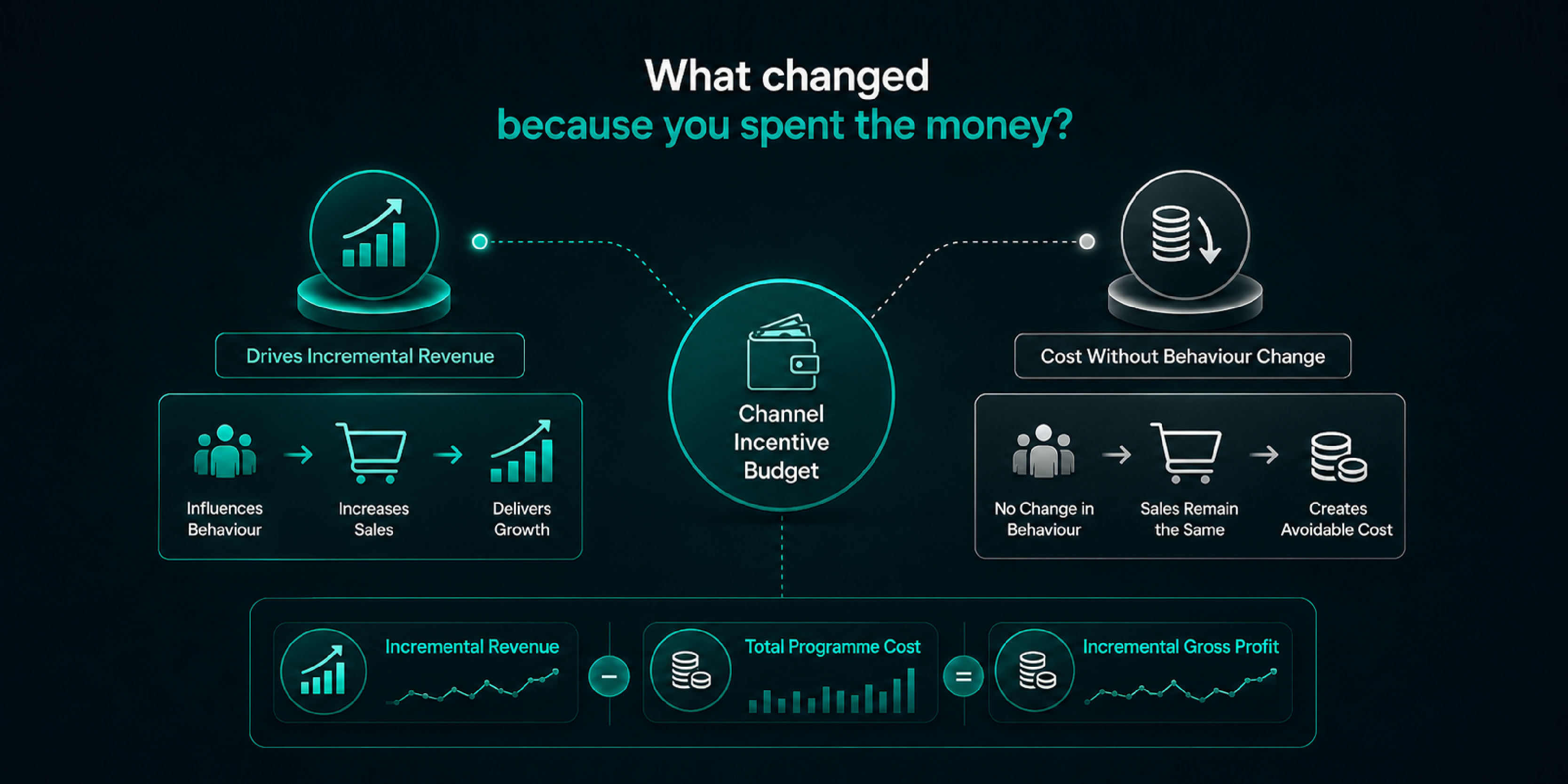
The strongest CXO question is therefore not, "Did sales increase?" It is, "What changed because we spent this money?"
How to Attribute Revenue to Incentive Spend When You Have Multiple Concurrent Channel Programmes
Attribution becomes difficult when partners participate in overlapping promotions, quarterly accelerators, product-specific incentives and long-term performance schemes.
Simply assigning all subsequent sales to the latest incentive creates false confidence.
Marketing measurement research increasingly uses methods such as marketing mix modelling and Shapley-based attribution to separate overlapping effects. Academic research published in 2024 specifically examined Shapley Value Regression for quantifying performance at individual channel-partner level when multiple influences affect outcomes.
CXOs do not always need sophisticated modelling to improve attribution. They do need disciplined baselines.
Start by establishing each partner's expected performance without the programme. Use historical sales, seasonality, territory trends, product availability and comparable partner groups. Then measure incremental movement against that baseline.
Where practical, create control or holdout groups. McKinsey's broader work on analytics and experimentation supports test-and-learn approaches because they provide stronger evidence of causality than simple before-and-after comparisons.
For concurrent programmes, assign each initiative a distinct behavioural objective. One may reward new account acquisition, another product mix, and another quarterly revenue acceleration. Avoid rewarding the same transaction repeatedly unless the economics explicitly justify it.
A platform such as Paytives can help centralise programme rules, partner performance, incentive calculations and payouts. This gives leadership a stronger data foundation for comparing programme cost against measurable partner outcomes rather than reconciling fragmented spreadsheets after the quarter closes.
The Incentive Audit Framework: What to Review, What Data You Need, and What to Do With the Findings
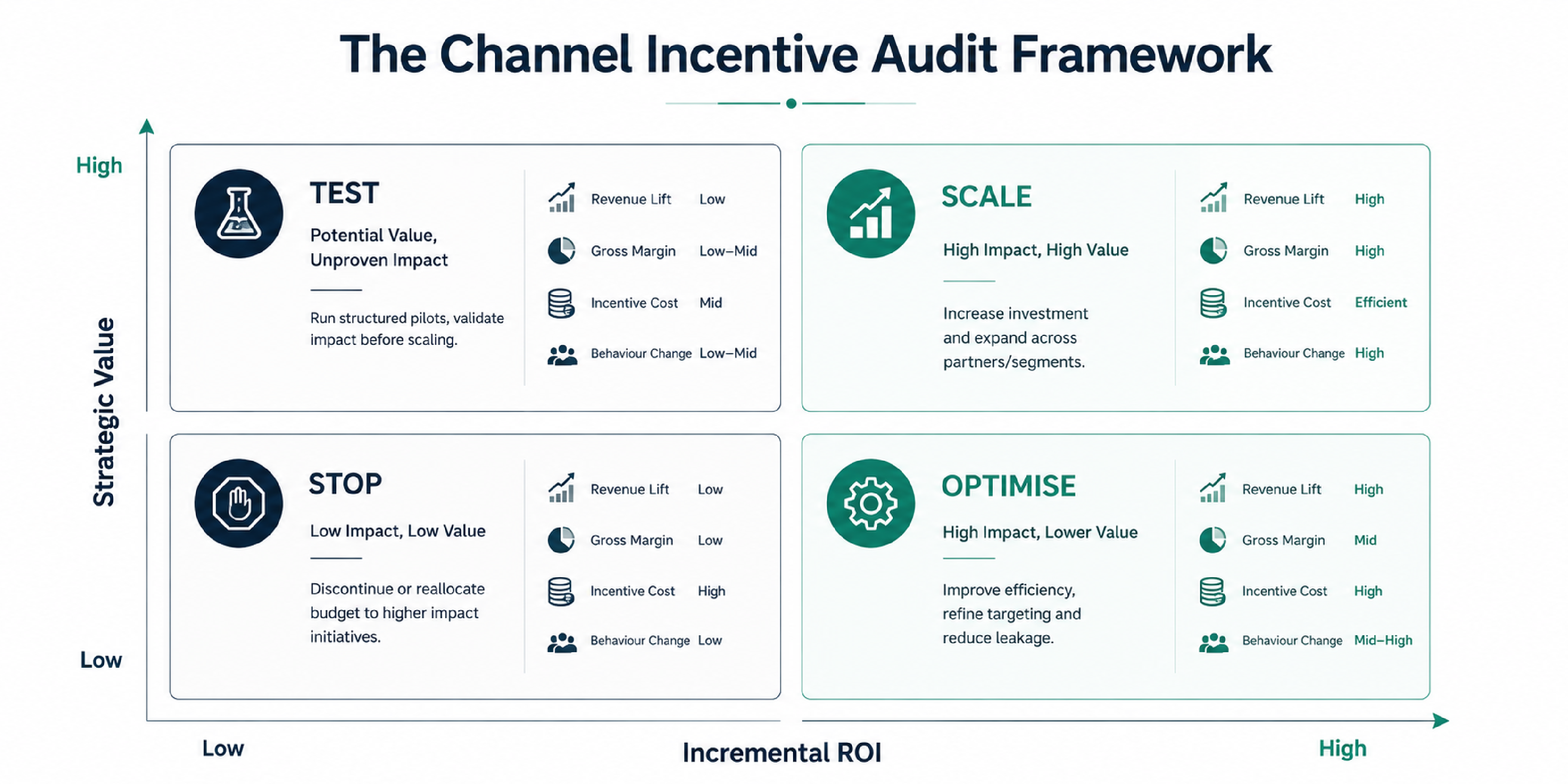
A useful incentive audit connects four layers: programme design, partner behaviour, commercial outcomes and programme economics.
1. Review programme design
Document every active incentive, its objective, eligible partners, qualifying behaviour, payout structure and duration. Gartner's partner management framework reinforces the value of structured processes and reliable partner data. If leadership cannot explain what behaviour an incentive intends to change, the programme needs redesign before further investment.
2. Build the minimum viable data set
Collect partner-level sales, baseline performance, incentive eligibility, actual payouts, gross margin, product mix, new account creation and relevant territory or seasonal factors.
3. Calculate incremental economics
Compare actual results against an expected baseline. Then calculate incremental gross profit, total programme cost and return on incentive spend.
4. Classify every programme
Place each programme into one of four categories:
- Scale: Strong incremental ROI and strategic value.
- Optimise: Positive returns, but inefficient targeting or payout design.
- Test: Insufficient evidence, requiring controlled experimentation.
- Stop: Negative economics with no compelling strategic justification.
Deloitte's work on performance management consistently stresses the value of frequent feedback and evidence-based adjustment rather than relying exclusively on annual review cycles. Channel incentives require the same discipline.
Organisations running several reward use cases can also benefit from understanding how a connected rewards infrastructure supports different stakeholder groups. The Reward Store's broader rewards platform ecosystem provides useful context on structuring rewards across employees, customers and channel partners.
Partner Stratification: How to Identify Which Partners Deserve More Incentive Investment, and Which Do Not
Equal incentive treatment rarely produces equal economic returns.
Bain's research on value creation has long highlighted the importance of concentrating resources around economically valuable relationships. Channel leaders should apply the same principle to partner investment while avoiding the assumption that today's largest partner automatically deserves tomorrow's largest incentive budget.
A practical stratification model assesses partners across three dimensions.
Current value measures revenue, gross margin and strategic contribution.
Growth potential measures addressable opportunity, market coverage and capacity to expand.
Incentive responsiveness measures whether partner behaviour actually changes when incentives change.
This creates more useful partner groups.
High-value, high-potential and highly responsive partners may justify increased investment. High-value but incentive-insensitive partners may require less incremental spend because they already perform strongly without additional rewards.
Low-performing partners with high potential may deserve targeted activation programmes rather than broad sales incentives. Persistently low-value, low-potential and low-response partners should receive limited discretionary investment.
This approach also addresses a common hidden cost: over-rewarding natural performance. A partner that would have delivered £5 million without an incentive should not receive the same incremental investment logic as a partner whose behaviour materially changes because of the programme.
Paytives supports this approach through real-time partner performance tracking, automated incentive calculation, multi-tier channel structures and gamified leaderboards. The objective is not simply faster payouts. It is better visibility into who earns incentives, why they earn them and whether that investment supports commercial priorities.
How to Restructure a Failing Channel Programme Without Destroying Partner Relationships
Stopping an ineffective incentive programme abruptly can create more damage than the original inefficiency.
Partners often incorporate expected incentives into their commercial planning. Removing them without explanation can feel like an economic penalty, even when the programme no longer delivers acceptable returns.
Start by changing the objective before changing the reward.
If a programme rewards total sales that partners would generate anyway, redirect incentives towards genuinely incremental behaviours such as acquiring new accounts, expanding product coverage or exceeding an evidence-based growth threshold.
Next, segment the transition. Do not impose identical changes across every partner. McKinsey's research on personalisation and granular commercial decision-making supports differentiated approaches based on customer or stakeholder characteristics. The same logic applies to partner ecosystems.
Third, communicate the commercial rationale clearly. Explain what will change, when it will change and how partners can succeed under the new structure. Avoid presenting programme optimisation as simple cost reduction.
Finally, phase major changes where possible. Test revised structures with selected partner groups, compare results against appropriate baselines and expand only when the economics improve.
The broader principle is consistency between incentives and strategic objectives. If your organisation also manages customer loyalty alongside channel engagement, Rekyndl illustrates how structured journeys, segmentation and measurable behavioural objectives can support more disciplined engagement models.
A failing programme does not always need cancellation. It needs evidence, sharper targeting and a clearer reason to exist.
Frequently Asked Questions
What is a channel incentive programme audit?
A channel incentive programme audit evaluates whether incentive spending creates incremental revenue, gross profit or strategically valuable partner behaviour. It reviews programme rules, partner performance, payouts, operating costs and expected baseline performance. The objective is to distinguish genuine incremental impact from sales that would probably have occurred without the incentive.
How do you calculate ROI on a channel incentive programme?
Calculate the incremental gross profit attributable to the programme, subtract total programme costs, then divide the result by total programme costs. Include incentive payouts, administration, technology and relevant fulfilment costs. Avoid using total revenue as the benefit because it can significantly overstate the programme's true contribution.
Why can a channel incentive programme increase revenue but still destroy value?
Revenue growth does not guarantee positive economics. Incentives may reward existing behaviour, shift sales between periods or encourage low-margin transactions. Bain's research on value creation supports evaluating economic contribution rather than growth in isolation, which means CXOs should examine incremental gross profit and total cost together.
When should a company stop a channel incentive programme?
A company should consider stopping or redesigning a programme when repeated analysis shows negative incremental returns, low behavioural impact or poor alignment with strategic priorities. One weak quarter may not provide enough evidence because seasonality and market conditions can distort results. Use several measurement periods or a controlled test before making a major decision.
Can Paytives help CXOs audit channel incentive ROI?
Yes. Paytives centralises incentive programme design, partner performance tracking, automated calculations and payouts. This gives decision-makers a clearer operational data foundation for comparing partner outcomes with incentive investment across programmes, tiers and markets.
Conclusion
A channel incentive programme creates value only when it changes partner behaviour in ways that generate incremental economic returns. CXOs should audit programmes against credible baselines, gross profit, total cost and partner-level responsiveness rather than relying on participation or headline sales.
As channel ecosystems become more data-driven, incentive budgets will increasingly move towards measurable, continuously optimised investment models. The organisations that build this discipline now will allocate partner capital with greater precision.
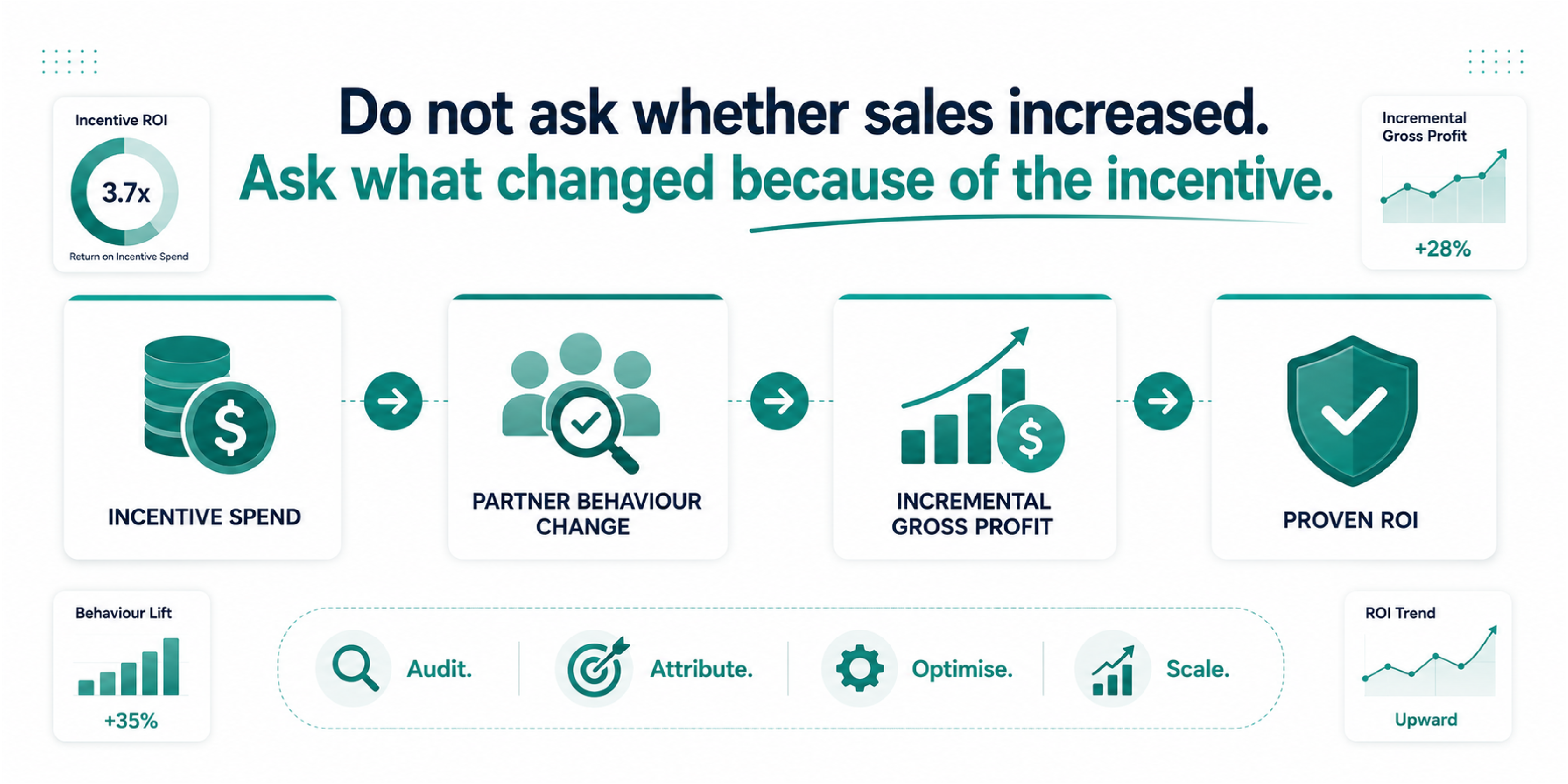
See how Paytives gives CXOs the channel analytics to audit and optimise incentive ROI. Explore how to build a more measurable channel incentive model.
Sign up for our newsletter for trending top content!


