
How to Plan Christmas Corporate Gifting in India: A Timeline for HR and Procurement

Sign up for our newsletter for trending top content!
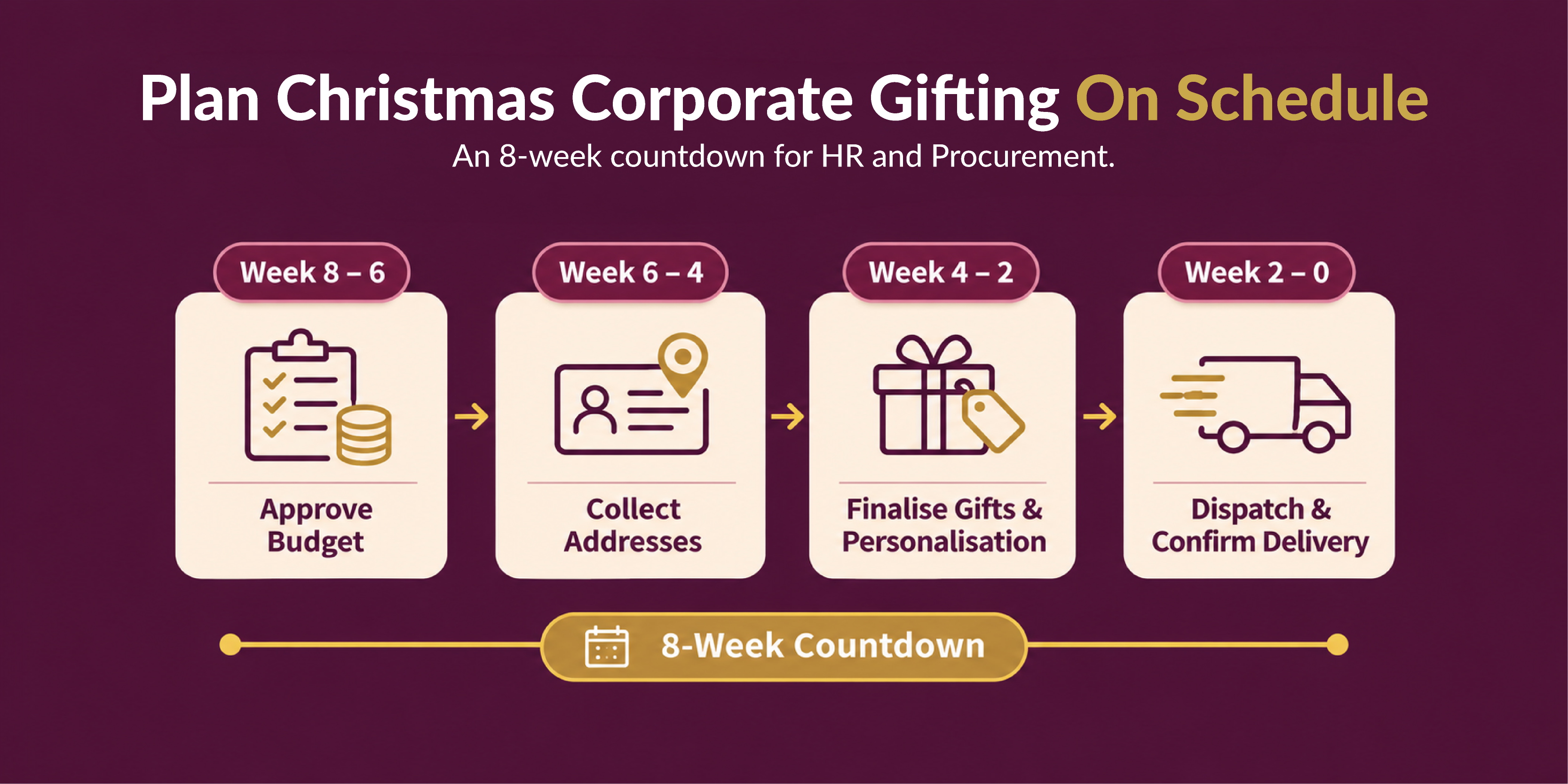
The most reliable way to plan Christmas corporate gifting in India is to work backwards from your December dispatch cutoff over eight weeks. Secure budget approval first, collect addresses second, lock gifts and personalisation third, and reserve the final weeks for dispatch and delivery confirmation.
Consider an illustrative scenario rather than a real case. A team approves its gift budget in the first week of December and then discovers that several addresses are out of date.
The gifts are ready, but the dispatch window has closed. This outcome is avoidable, and this guide shows how to avoid it with a simple countdown that HR and procurement can share.
Christmas Corporate Gifting India: Begin With the December Dispatch Cutoff
Every date in your plan depends on one decision. That decision is the last day on which gifts can leave the warehouse and still reach recipients before Christmas.
Ask your supplier or logistics partner for the last safe dispatch date for each region. Then add a buffer of several working days, because remote locations and metro cities may not share the same cutoff.
Working backwards works because each task has a fixed deadline set by the task that follows it. A late budget approval, for example, compresses every later step.
This guide treats the dispatch cutoff as Week Zero and counts backwards. If your cutoff falls in the second week of December, Week Eight begins in the middle of October.
If you are reading this with fewer than eight weeks remaining, do not abandon the plan. Run budget approval and address collection at the same time, and shorten each review step.
Your Eight Week Countdown
Use this countdown as a shared checklist for HR, procurement and finance.
- In Week Eight, send the budget proposal to finance.
- By the end of Week Six, confirm the approved budget and recipient groups in writing.
- In Week Six, send the address form to every recipient.
- By the end of Week Four, close the address list and verify it.
- By the end of Week Four, approve the gift selection and personalisation proofs.
- By the end of Week Two, place the final order and share the recipient file with your supplier.
- From Week Two to Week Zero, dispatch gifts, track progress and confirm every delivery.
Weeks Eight to Six: Secure Budget Approval First
Procurement cannot confirm gifts, vendors or quantities until a budget ceiling exists. For that reason, budget approval is the first task and deserves the most attention.
Prepare a one page proposal for finance. It should state the total ceiling, the recipient groups, the range for each group and the person who owns the decision.
Procurement can add value here by comparing at least two suppliers against the same criteria, which are range, personalisation options, regional coverage and delivery reporting.
Separate three recipient groups: employees, clients and partners. Each group has a different purpose, a different value range and often a different approval path.
Agree the following points with finance at this stage:
- Name the cost centre that will carry the total spend.
- Confirm whether the ceiling includes delivery charges and applicable taxes.
- Ask finance to confirm the tax treatment of gift expenses.
- Decide who may approve changes after sign off.
- Keep a small reserve for late joiners and replacement gifts.
Record the decision in an email or approval note. A written record protects both HR and procurement if the scope changes later.
Weeks Six to Four: Collect Addresses Without Chasing Everyone
Address collection is the slowest step, because it depends on other people replying. Start early and make replying as easy as possible.
Draw recipient names from the HR system for employees, the CRM for clients and the relationship owner for partners. Merge them into one master sheet rather than several.
Send one short form to everyone. Request the following details:
- Record the full name exactly as it should appear on the label.
- Collect the complete address, including the PIN code and a landmark.
- Ask for a mobile number that the courier can call.
- Offer a choice between home delivery and office delivery.
- Ask for any food or cultural preference that affects gift choice.
Keep a log of every reply and every reminder. A simple status column showing requested, received or verified lets anyone see progress at a glance.
Remote and hybrid employees may not be at their desks in late December, so offering a home delivery option is sensible.
Set a firm response date, send two reminders and name one person who will resolve gaps by phone. Verify addresses before the list is closed.
Treat addresses as personal data. Collect only what delivery requires, keep the sheet in a restricted location and delete it when the programme ends.
Weeks Four to Two: Finalise Gifts and Lock Personalisation
Choose gifts only after headcount and budget ceilings are certain. Selecting earlier risks ordering for a list that later changes.
Match each gift to the relationship. Employees may appreciate something festive and useful, while clients and partners may expect something refined that suits a business setting.
Apply these practical filters before approving any item:
- Check that no item expires or spoils within the delivery window.
- Choose festive designs that feel inclusive for a workforce of many faiths.
- Confirm that every region on your list can be served.
- Request a sample and review the packaging before approving the full order.
Decide early what will be personalised, such as a name, a message or a company logo. Request proofs and approve them in writing.
Personalised items cannot easily be reworked once production begins, so verify the spelling of every name before it goes for printing.
Write a short note to enclose with each gift. A personal line from a manager or account owner carries more weight than a generic greeting.
Set a freeze date for list changes. After that date, give late joiners a gift from the reserve instead of altering the main order.
Weeks Two to Zero: Dispatch and Confirm Every Delivery
Place the confirmed order and share the final recipient file with your supplier. Do this at least two weeks before the cutoff so that no step is rushed.
Agree in writing how the supplier will report dispatch, delays and failed deliveries. Ask for a status summary at regular intervals during the dispatch window.
Delivery confirmation is a record, not an assumption. Track every gift against one of four statuses:
- Mark a gift as delivered when the date and the receiver are recorded.
- Mark a gift as delayed when it has missed its expected date.
- Mark a gift as returned when the courier could not hand it over.
- Mark a gift as undeliverable when the address or contact details are wrong.
Share a simple escalation path before dispatch begins. Name who decides on a resend, who informs the recipient and who updates the delivery record.
Assign one person to resolve failed deliveries by phone and to arrange a resend wherever the calendar allows.
For client and partner gifts, ask account managers to confirm receipt personally. A short thank you call also tells you whether the gift arrived in good condition.
After Christmas, reconcile the delivery record with supplier invoices and note what you would change next year. This turns one season of effort into a reusable process.
Frequently Asked Questions
When should we start planning Christmas corporate gifting in India?
Start about eight weeks before your December dispatch cutoff. This gives finance time to approve the budget, gives recipients time to reply and leaves a buffer before dispatch. If time is short, run budget approval and address collection together.
How should HR set a Christmas gifting budget for employees, clients and partners?
Set a separate ceiling for each group, because each serves a different purpose. Base the total on headcount and relationship value, agree it with finance in writing, and hold a small reserve for late joiners and replacements.
How do I collect employee addresses for gifts without chasing everyone?
Send one short form with a firm response date and two reminders. Offer home or office delivery, explain how the data will be used, and name one person who can resolve gaps by phone.
What is the last date to dispatch Christmas gifts in India?
There is no single date, because it depends on your supplier and on each destination. Ask for the last safe dispatch date for every region, then add a buffer of several working days to set your own cutoff.
How do I confirm that corporate gifts have been delivered?
Track every gift as delivered, delayed, returned or undeliverable, and record the date and the receiver. Ask account managers to confirm client and partner gifts personally, and assign one person to resolve failures.
Conclusion
A dependable Christmas gifting plan has one anchor, which is the dispatch cutoff, and four checkpoints, which are approved budget, verified addresses, locked personalisation and confirmed delivery.
Print the countdown, assign an owner to each line and review progress every week. Small, regular reviews keep the plan on schedule.
Teams that fix these dates early have room to handle surprises calmly, and procurement gains a clear record for the following year.
For teams that prefer curated options, Cherishd is the physical gifting product of The Reward Store. It offers curated gifts and gift boxes from 500+ Indian brands for employee, client and partner gifting.
Sign up for our newsletter for trending top content!


