
How to Use Recognition to Retain Employees Through the Year End Resignation Window

Sign up for our newsletter for trending top content!
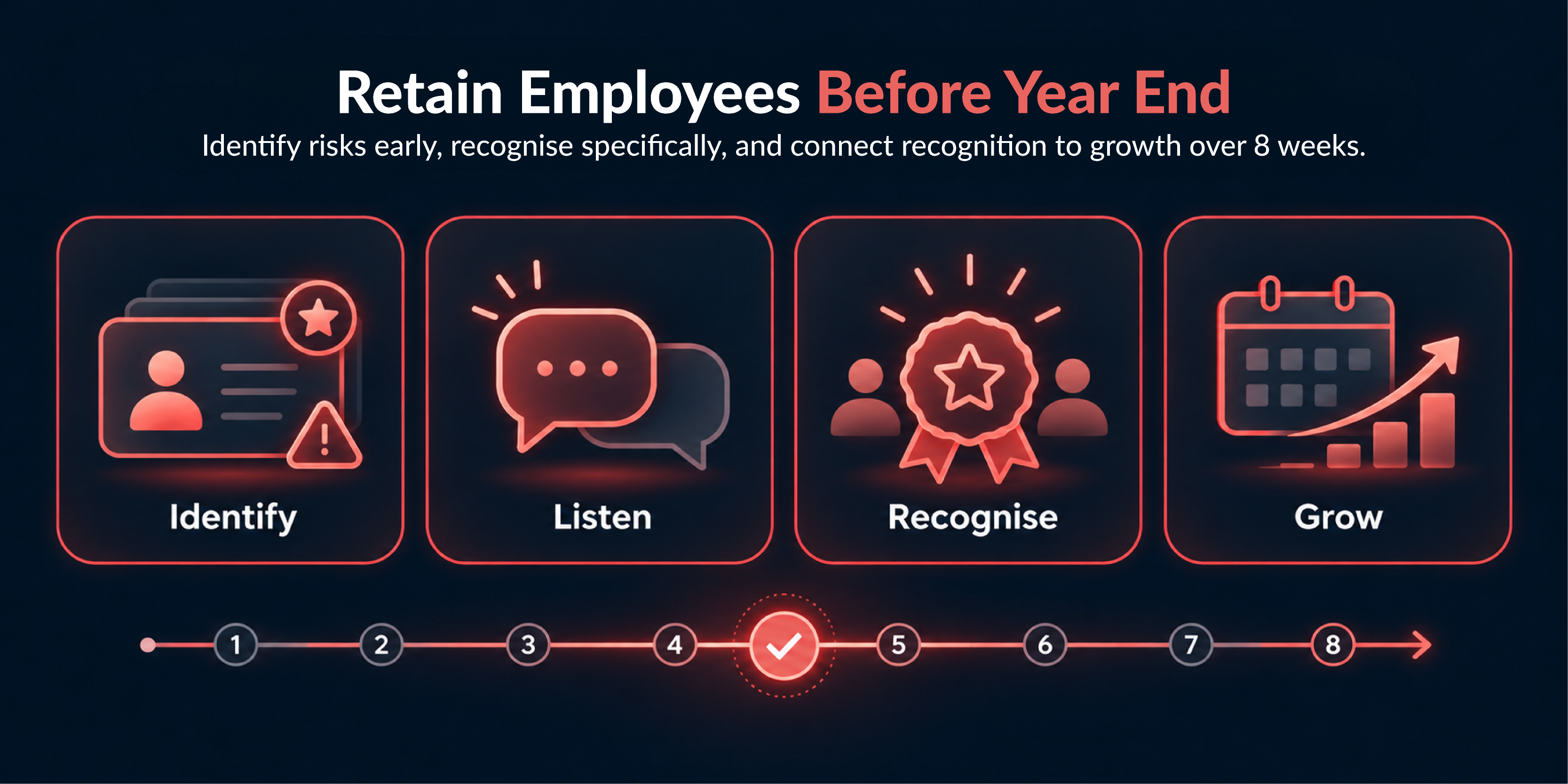
Use recognition to retain employees through the year end resignation window by identifying likely leavers early, giving each a specific and timely acknowledgement from their manager and peers, and linking that recognition to a real conversation about their future. Over eight weeks, this makes employee retention year end a planned effort rather than a last minute reaction.
Consider an illustrative scenario. A team of ten has just closed a demanding year. The manager is relieved, the appraisal cycle is weeks away, and one of the strongest performers has quietly updated a professional profile.
This article sets out an eight week plan for November and December that HR leaders and people managers in India can start this week.
Why employee retention year end planning needs to start now
Year end is when many people take stock of their careers. Appraisals, bonus conversations and the festive break all invite reflection, and a resignation can follow soon after.
In many Indian organisations, the appraisal and bonus cycle settles in the first quarter. An employee who feels unseen in November may wait for those results and then leave.
A resignation received in January is usually the end of a decision that began months earlier. By then, recognition can feel like a counteroffer rather than genuine appreciation.
The practical consequence is simple. The most useful recognition happens before an employee has decided to go, while the relationship is still open and a conversation can change the outcome.
Recognition is not a substitute for fair pay or a credible career path. It is, however, one of the few levers that a manager controls fully within eight weeks.
Identify the employees most likely to leave in Q1
You cannot predict resignations with certainty, but managers usually sense risk before HR does. Ask each manager to name the people they would find hardest to replace, and then test that list against these signals.
- A strong performer has not been promoted or given new scope for a long time.
- An employee was recently passed over for a project, a role or a visible assignment.
- A previously vocal colleague has become quiet in meetings and discussions.
- A person with a skill that is in demand in the market has received no recent acknowledgement.
- An employee carried extra work after a colleague left and was never thanked for it.
Do not rely on tenure or seniority alone when building the list. Newer employees who were hired for their skills can be just as likely to move as long serving colleagues who feel overlooked.
Also consider employees whose circumstances are changing, such as someone returning from leave or a person whose role has shifted after a restructure. Such moments are natural points of reconsideration.
Keep this list confidential and treat it as a prompt for care, not as a label. The aim is to make sure that valued people feel valued, not to monitor them.
The eight week recognition plan for November and December
Weeks 1 to 4 fall in November and weeks 5 to 8 fall in December. If you are starting late, combine weeks 1 and 2 and keep the remaining order.
Each week asks for roughly one conversation or one message per employee, so the effort is modest. The difficulty lies in doing the steps in sequence and on time.
- In week 1, managers prepare the confidential list of at risk employees, and HR agrees with each manager who will own each relationship.
- In week 2, each manager holds a short one to one conversation to learn what the employee values, such as growth, visibility, flexibility or reward.
- In week 3, the manager gives the first piece of specific recognition, naming the work done, the effect it had and why it mattered.
- In week 4, peers are invited to recognise the same person for something concrete, so that appreciation comes from colleagues as well as the manager.
- In week 5, a senior leader acknowledges the employee personally, ideally in front of the wider team and with a specific example.
- In week 6, the manager pairs recognition with a stretch opportunity, a learning option or a clearer view of the next role.
- In week 7, the team marks the year end with a reward chosen to suit the individual, together with a short written note explaining the reason.
- In week 8, the manager holds a forward looking conversation about the first quarter and records the commitments that were made.
These four questions give the week 2 conversation a useful shape.
- Which part of your work this year are you most proud of?
- What would make the next year more rewarding for you?
- Which skill would you like to build or use more often?
- How would you prefer to be thanked when something goes well?
Give every step an owner and a date in a shared tracker. HR should check progress at the end of each week, because plans of this kind often fail through delay rather than disagreement.
Run the plan for the whole team, so that no one feels singled out. The employees on your list simply receive the most careful attention.
Rules that keep recognition credible
Make every message specific. A message that names the action, its effect and the value behind it is believed, whereas generic praise is quickly forgotten.
Use a four part message. Name the action, describe its effect, state the value behind it and mention the next step.
For example, a manager might tell an analyst that a rebuilt reporting process spared the team repeated rework, that it shows real care for accuracy, and that the analyst could lead the next one.
Keep recognition timely and honest. Praise that arrives weeks after the work, or that ignores a genuine grievance, can look like an attempt to buy silence.
Match the form to the person. Some employees value public thanks, others prefer a private note, and a few would rather receive a development opportunity than a gift.
Watch fairness across the team. If the same people are always thanked, the others notice quickly, and the plan will damage trust instead of building it.
Do not announce the plan as a retention exercise. Employees who sense that they are being managed will trust the praise less.
Measure what you can with your own data. Track exits, early resignation conversations and manager follow through in the first quarter, and compare them honestly with earlier periods.
Where a recognition platform helps and where it does not
A spreadsheet and a shared calendar are enough to run this plan for a small team. Larger organisations often find that keeping managers consistent is the harder part.
Many managers hesitate to recognise someone they fear may leave, in case it looks like a bribe. Sincere and specific appreciation is not a bribe, and silence is the more costly choice.
Whichever route you choose, agree the rules first. Decide who may recognise whom, what a good message contains and how rewards are approved.
ApplaudIQ is the employee recognition and rewards platform from The Reward Store. Managers and peers use it to recognise employees and reward them, which matches the manager and peer steps in weeks 3, 4 and 7.
No tool can supply the conversation itself. A platform can carry the recognition, but the manager must still listen, follow up and mean what is said.
Frequently asked questions
How do you reduce employee attrition at the end of the year?
Start early, identify the people most likely to leave, and give each of them specific recognition from their manager and peers. Then hold an honest conversation about growth and the first quarter. Recognition works best when it is paired with a visible next step.
Why do employees resign after appraisals and bonuses?
Appraisal and bonus outcomes often settle what an employee has been waiting for. If the result disappoints, or if the person felt unrecognised during the year, the decision to leave becomes easier. Timely recognition and honest conversations before results arrive can change that outcome.
What is the best way to recognise an employee who is thinking of quitting?
Be specific, be sincere and be timely. Name the work they did and its effect, involve their manager and peers, and then ask what they want from the next year. Recognition cannot replace pay or growth, but it can reopen a conversation.
Can recognition alone stop people from resigning?
No. Recognition shows people that they are valued, but employees also weigh pay, growth, workload and their manager. It works best alongside fair pay decisions and a clear career path, and it should never be used to avoid a difficult conversation.
How do you know whether a recognition plan is working?
Compare voluntary exits and early resignation conversations in the first quarter with your own earlier periods. Also ask managers whether at risk employees now speak openly about their plans. Treat these as indicators, not proof, because many factors affect resignations.
Conclusion
The year end window rewards organisations that act before resignations arrive. An eight week plan gives managers a clear sequence of identifying, listening, recognising, involving peers, connecting to growth and talking about the future.
The plan is deliberately simple because the strongest retention tool at year end is attention. People stay where their work is noticed, their growth is discussed and their manager is honest with them.
Start with the confidential list this week, so that the first conversations happen before the festive break.
Book a Demo to see how ApplaudIQ lets managers and peers recognise and reward employees.
Sign up for our newsletter for trending top content!


