
How to Design Birthday and Anniversary Loyalty Campaigns That Feel Personal and Drive High-Value Purchases


Sign up for our newsletter for trending top content!
Introduction
Birthday and anniversary campaigns consistently outperform almost every other lifecycle communication. Research from Experian found that birthday emails generate significantly higher transaction rates than standard promotional emails, while Bain & Company reports that increasing customer retention by just 5 per cent can increase profits by between 25 and 95 per cent. These moments represent a rare opportunity when customers already expect brands to acknowledge them, making them highly receptive to personalised offers.
Yet many retail and e-commerce brands still rely on generic discount codes sent on the customer's birthday with little relevance to previous purchases or shopping behaviour. The result is predictable. Customers redeem the incentive once, but fail to develop long term loyalty or increase their spending.
This article explains how marketing leaders can design birthday and anniversary loyalty campaigns that feel genuinely personal, increase purchase value, strengthen customer relationships, and deliver measurable commercial outcomes through intelligent lifecycle automation.
Why Birthday Emails Have the Highest Open Rate of Any Loyalty Communication. Why Most Brands Waste It
Birthday communications occupy a unique position within customer marketing. Unlike promotional campaigns that compete with hundreds of commercial messages, birthday emails arrive during a moment customers already associate with celebration and recognition. Experian's Email Benchmark research found that birthday emails generate substantially higher open rates, click rates and transaction rates than standard promotional campaigns because they align with personal intent rather than promotional interruption.
However, high open rates do not automatically translate into higher revenue. Many brands treat birthdays as a simple discount event instead of using them as an opportunity to deepen customer relationships.
Customers expect recognition, not automation
Research from Deloitte shows that customers increasingly reward brands that recognise their preferences, history and individual needs rather than treating every customer identically. A generic birthday voucher with identical messaging for every customer quickly signals that the campaign exists for the brand's benefit rather than the customer's.
Marketing leaders should therefore ask a different question.
Instead of asking, "What discount should we send?", ask, "Why should this customer care about opening this message?"
The answer usually lies in relevance.
A customer who frequently purchases premium fashion products should not receive the same reward as someone who primarily shops for household essentials. Likewise, loyal customers with several years of purchase history deserve recognition that reflects the value of that relationship.
The biggest missed opportunity is personal context
According to McKinsey & Company, organisations that excel at personalisation generate faster revenue growth and improve customer satisfaction because they deliver experiences based on customer behaviour rather than broad demographic assumptions.
Effective birthday campaigns combine several data points, including:
- Previous purchase categories.
- Average order value.
- Loyalty tier.
- Preferred shopping channel.
- Redemption history.
- Time since last purchase.
When these signals shape the reward, customers perceive genuine recognition instead of another automated promotion.
Retail and e-commerce brands using Rekyndl can automate these decisions through customer segmentation and journey orchestration. Rather than sending one birthday message to every member, marketers can create dynamic journeys that tailor offers according to customer value, buying behaviour and engagement history. This approach improves both customer experience and campaign profitability while reducing manual campaign management.
The difference is significant. High performing birthday campaigns do not succeed because they include rewards. They succeed because customers believe the brand understands them.
Timing the Birthday Reward: Before, On, or After. What the Data Says About When to Send
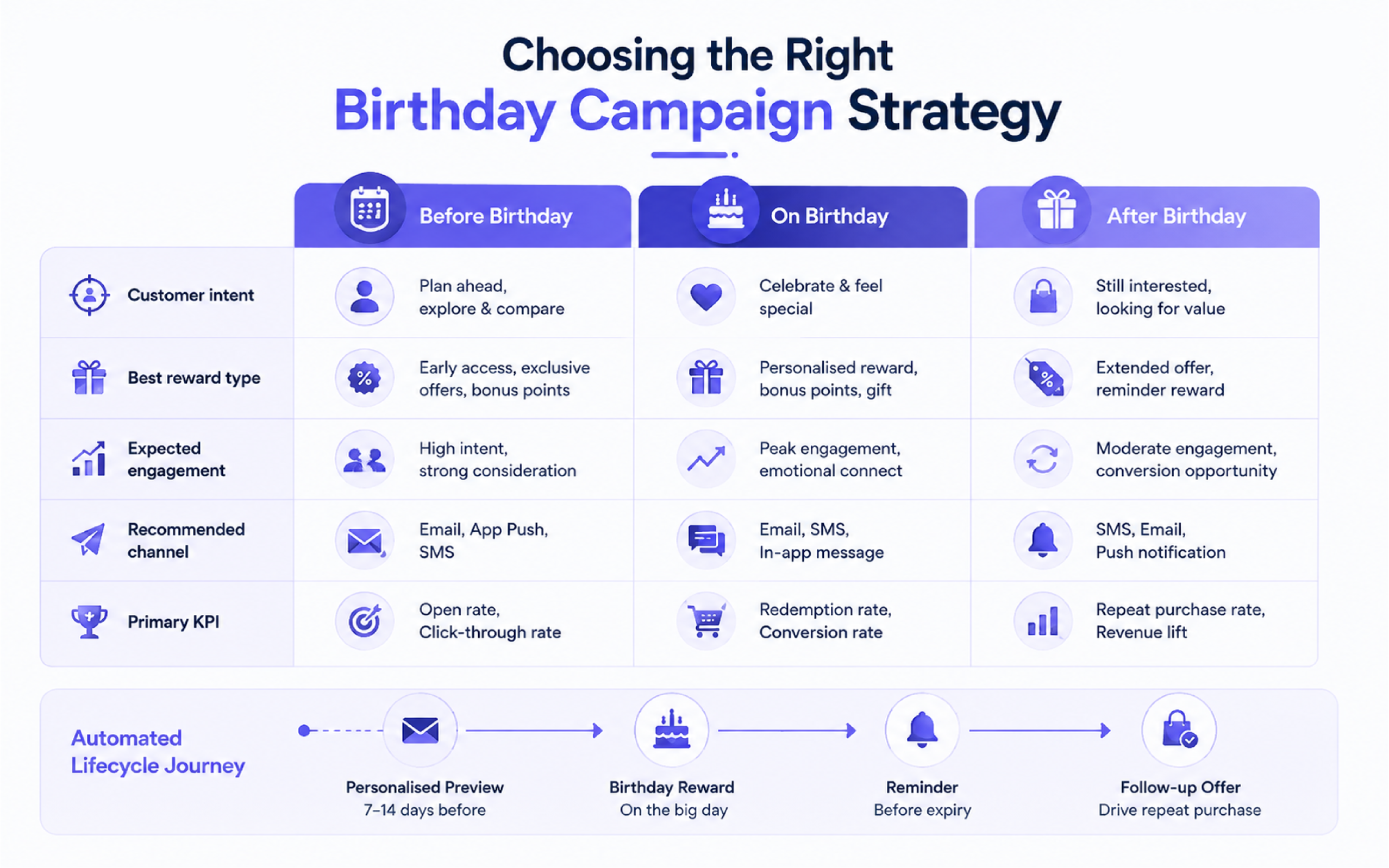
Choosing the right offer matters, but timing often determines whether that offer converts into revenue.
Research from Forrester consistently shows that customer engagement improves when brands interact at moments of genuine relevance rather than according to fixed campaign calendars. Birthday campaigns illustrate this principle clearly. Customers do not all shop on their birthday. Many plan celebrations in advance, while others postpone purchases until afterwards.
Instead of relying on a single email sent on the customer's birthday, marketers should design campaigns that reflect different purchasing behaviours.
Comparing birthday reward timing
This staged approach aligns with behavioural research from Gartner, which highlights that customer journeys rarely follow a single interaction. Multiple contextual touchpoints consistently outperform isolated communications because they accommodate different decision making patterns.
Build a journey instead of a campaign
Leading retailers increasingly replace one-off birthday emails with automated lifecycle journeys.
A typical journey might include:
- A personalised preview seven days before the birthday.
- A birthday message featuring an individually relevant reward.
- A reminder before reward expiry.
- A follow up recommendation based on browsing or purchase behaviour.
This structure keeps the conversation active without overwhelming customers.
Rekyndl enables marketers to automate these journeys through behaviour based triggers, customer segmentation and multi-channel delivery across email, SMS, push notifications, in app messaging and in store experiences. Instead of manually scheduling campaigns every month, marketing teams can create always on birthday journeys that continuously adapt to customer behaviour.
The most successful birthday campaigns therefore optimise more than creative design. They optimise timing, sequencing and customer context together. When marketers treat birthdays as a lifecycle journey instead of a single promotional event, they consistently increase redemption rates, average order value and long term customer retention, reinforcing Bain & Company's conclusion that retaining existing customers delivers disproportionately higher long term profitability than continually acquiring new ones.
Personalising Beyond the Name: How to Use Purchase History to Make Birthday Offers Feel Individually Relevant
Adding a customer's first name to an email subject line no longer counts as meaningful personalisation. Modern consumers expect brands to recognise what they buy, how often they shop and what motivates them to return. McKinsey & Company found that companies that excel at personalisation generate faster revenue growth and significantly improve customer satisfaction because they tailor experiences using behavioural data rather than basic demographic information.
For marketing leaders in retail and e-commerce, the challenge is not collecting data. Most organisations already hold valuable first party data through loyalty programmes, websites, mobile applications and point of sale systems. The challenge lies in turning that information into relevant birthday experiences.
Move from demographics to behaviour
Purchase history provides richer insight than age or location alone. Instead of sending identical rewards to every loyalty member, marketers should group customers according to behavioural characteristics such as:
- Frequently purchased product categories.
- Average order value.
- Purchase frequency.
- Preferred shopping channel.
- Time since last purchase.
- Reward redemption history.
- Loyalty tier and lifetime value.
This approach enables brands to send rewards that complement established buying habits rather than interrupt them. For example, a customer who regularly purchases premium homeware may respond better to early access, exclusive collections or bonus loyalty points than to a broad percentage discount. Likewise, customers who consistently purchase during seasonal events may appreciate an extended redemption window that fits their shopping pattern.
Build dynamic journeys instead of static campaigns
Research from Gartner shows that customers increasingly expect brands to deliver contextually relevant interactions throughout the customer journey. Static campaigns cannot respond to changing behaviour, whereas automated journeys continuously adjust based on customer actions.
Rekyndl enables marketing teams to create dynamic birthday journeys using customer segmentation, purchase behaviour and lifecycle triggers. A customer who redeems a birthday reward can automatically move into a post purchase nurture sequence, while someone who ignores the initial message can receive an alternative incentive before the reward expires. This automation removes manual effort while ensuring every interaction reflects the customer's current relationship with the brand.
Personalisation succeeds when customers feel recognised rather than categorised. The richer the behavioural insight, the more valuable every birthday interaction becomes.
Anniversary Rewards vs Birthday Rewards: The Different Psychology Behind Each and What It Means for Offer Design
Birthday and anniversary campaigns often sit within the same lifecycle calendar, yet they trigger different emotional responses. Treating them as interchangeable limits both engagement and commercial performance.
Behavioural research published in the Journal of Consumer Research suggests that personal milestones influence purchasing decisions differently depending on whether the occasion celebrates the individual or the relationship. Birthdays focus on personal recognition, while anniversaries reinforce commitment and continued belonging.
For loyalty programmes, this distinction should shape both messaging and reward design.
Birthday versus anniversary campaigns
Bain & Company consistently highlights that loyal customers become more profitable over time because they purchase more frequently, spend more per transaction and generate referrals. Anniversary campaigns should therefore reinforce the ongoing value of programme membership rather than encourage a single transaction.
Reward loyalty, not just longevity
Many brands send identical anniversary vouchers every year regardless of customer engagement. This approach overlooks the relationship customers have built with the brand.
Instead, anniversary campaigns should acknowledge milestones in meaningful ways. Examples include:
- Additional loyalty points based on membership tier.
- Early access to exclusive collections.
- Personalised recommendations linked to previous purchases.
- Recognition of spending milestones achieved during the year.
- Limited time experiential rewards that reinforce premium membership.
Customers should feel that the relationship has evolved rather than repeated.
Marketing leaders who separate birthday and anniversary strategies create more emotionally relevant communications. Birthday campaigns stimulate immediate purchasing behaviour, while anniversary campaigns strengthen long term commitment and increase customer lifetime value.
How to Use Birthday Campaigns to Re-engage Lapsed Members Who Are Otherwise Unresponsive
Lapsed loyalty members rarely return because they receive another promotional email. Most disengage gradually after their shopping habits change, competing priorities emerge or previous campaigns lose relevance. Birthday campaigns provide a natural opportunity to restart that relationship because customers remain receptive to messages that acknowledge a personal milestone.
Research from Forrester shows that lifecycle marketing consistently outperforms batch promotional campaigns because it responds to customer behaviour instead of relying on generic communications. A birthday represents one of the strongest behavioural triggers available to marketers.
Identify which customers are worth winning back
Not every inactive member requires the same strategy. Marketing leaders should first segment customers according to factors such as:
- Time since last purchase.
- Historical spend.
- Previous campaign engagement.
- Loyalty tier.
- Product preferences.
- Customer lifetime value.
High value customers who have not purchased for six months deserve a different experience from occasional shoppers who only joined recently.
Replace discounts with renewed relevance
Many brands attempt re-engagement by increasing discount values. Deloitte's consumer research indicates that relevance often influences purchasing decisions more strongly than price alone, particularly among customers who already have an established relationship with a brand.
A stronger approach combines recognition with personalisation. Marketing teams can:
- Recommend products based on previous purchases.
- Offer bonus loyalty points for returning within a defined period.
- Extend redemption windows for previously engaged members.
- Trigger follow up communications based on browsing behaviour after the birthday message.
Instead of focusing solely on one transaction, the objective becomes restarting the customer's lifecycle journey.
Rekyndl supports this strategy through automated win back journeys that combine behavioural segmentation, multi-channel messaging and reward orchestration. Marketing teams can identify inactive loyalty members, trigger personalised birthday experiences and automatically adjust follow up communications according to customer engagement. This creates a scalable reactivation process rather than a manual campaign repeated each year.
Birthday campaigns should therefore serve two purposes. They celebrate the customer while creating a compelling reason to begin a new purchasing cycle. When marketers connect recognition with behavioural insight, even previously inactive members become significantly more likely to return, purchase again and remain engaged over the long term.
Measuring Birthday Campaign ROI: Revenue Per Triggered Campaign and Incremental Purchase Lift
Marketing leaders increasingly face pressure to prove that loyalty campaigns contribute to commercial growth rather than simply improving engagement metrics. High open rates and redemption percentages indicate campaign activity, but they do not demonstrate business impact. Gartner advises organisations to align marketing measurement with revenue outcomes, while Bain & Company consistently identifies customer lifetime value and retention as stronger indicators of sustainable growth than campaign level metrics alone.
Birthday and anniversary campaigns should therefore be evaluated against incremental commercial performance.
Build an ROI measurement framework
The following metrics provide a balanced view of campaign effectiveness.
Look beyond the first transaction
McKinsey & Company recommends measuring the downstream effect of personalisation rather than focusing exclusively on immediate conversions. A birthday reward may encourage an initial purchase, but its greater value often lies in increasing future purchase frequency, strengthening loyalty and encouraging continued participation in the programme.
Marketing teams should also establish control groups wherever possible. Comparing customers who receive a birthday journey against similar customers who do not receive one provides a clearer picture of incremental revenue and purchase lift. This approach removes the influence of seasonal demand and other external factors.
Rekyndl supports this measurement strategy through campaign analytics, customer segmentation and automated journey reporting. Marketing leaders can attribute revenue to specific lifecycle campaigns, compare segment performance and refine future birthday and anniversary journeys using measurable outcomes rather than assumptions.
Ultimately, the most successful birthday campaigns are not those that distribute the highest value rewards. They are those that consistently generate profitable customer behaviour over time.
Frequently Asked Questions
What is the best birthday loyalty reward campaign personalisation strategy in India?
The most effective strategy combines behavioural segmentation with automated lifecycle journeys. Rather than sending identical rewards to every customer, retailers should personalise offers using purchase history, loyalty tier, average order value and engagement history. This approach increases relevance and improves both redemption rates and incremental revenue, as supported by McKinsey's research on personalisation.
When should brands send birthday loyalty rewards?
Most retailers achieve the strongest results by using a sequence of communications rather than a single message. Sending an initial reward seven to fourteen days before the birthday gives customers time to plan purchases, while a message on the birthday reinforces emotional recognition. A reminder before reward expiry helps recover customers who have not yet redeemed the offer.
How are anniversary rewards different from birthday rewards?
Birthday rewards celebrate the individual and often encourage immediate purchases. Anniversary rewards recognise the customer's ongoing relationship with the brand and should reinforce loyalty through milestone recognition, exclusive access or loyalty benefits. The objectives, messaging and success metrics should therefore differ.
Can birthday campaigns reactivate inactive loyalty members?
Yes. Birthday campaigns provide a natural opportunity to reconnect with customers who have stopped engaging with regular promotions. Personalised offers based on previous purchasing behaviour generally perform better than broad discounts because they remind customers why they originally joined the loyalty programme. Behaviour based follow up journeys further improve reactivation rates.
How does Rekyndl automate birthday and anniversary campaigns?
Rekyndl enables marketing teams to create automated lifecycle journeys using customer segmentation, purchase history, loyalty milestones and behavioural triggers. It delivers personalised communications across email, SMS, push notifications and other customer touchpoints while providing reporting that links campaign activity directly to revenue and customer retention outcomes.
Conclusion
Birthday and anniversary campaigns deliver their greatest value when brands treat them as intelligent lifecycle journeys rather than one off promotional events. Behavioural personalisation, thoughtful timing and meaningful recognition consistently outperform generic discount campaigns because they strengthen long term customer relationships as well as immediate revenue.
As first party data becomes increasingly important and customer expectations continue to rise, marketers who automate personalised milestone campaigns will gain a lasting competitive advantage. The next generation of loyalty programmes will reward relevance as much as rewards themselves.
See how Rekyndl automates birthday and anniversary loyalty journeys
Discover how Rekyndl helps retail and e-commerce brands build personalised birthday and anniversary campaigns using behavioural segmentation, automated customer journeys and measurable revenue reporting.
Explore Rekyndl Features: https://www.therewardstore.com/rekyndl/features
Sign up for our newsletter for trending top content!


