
How Can Rewards Programmes Activate Dormant Bank Customers and Increase Engagement?

Sign up for our newsletter for trending top content!
Introduction
Banks spend significant resources acquiring new customers, yet many accounts become inactive within months of onboarding. According to Bain & Company, increasing customer retention by just 5 per cent can increase profits by 25 to 95 per cent, making customer activation one of the highest-return marketing priorities in banking. Rather than relying solely on acquisition campaigns, Marketing Leaders are increasingly using rewards programmes to encourage first transactions, repeat engagement, and long-term loyalty. A well-designed activation strategy turns dormant customers into active users by rewarding meaningful behaviours at every stage of the customer journey.
This article explains how rewards programmes drive customer activation in banking, which trigger events generate the strongest response, how to design an effective activation journey, and how platforms such as Rekyndl help automate personalised engagement across the customer lifecycle.
Why Do Many Bank Customers Become Dormant After Onboarding?
Dormancy rarely happens because customers dislike a bank. More often, customers simply fail to develop regular usage habits during the first few weeks after opening an account. McKinsey identifies the first stages of the customer journey as the most influential period for establishing long-term engagement. If customers do not complete meaningful actions early, they are less likely to become profitable relationships.
Several factors contribute to inactivity:
- Customers receive little communication after account opening.
- Activation incentives lack personal relevance.
- Onboarding journeys focus on compliance rather than engagement.
- Customers fail to understand available products and benefits.
- Marketing messages arrive too late or too frequently.
For Marketing Leaders, activation should focus on behaviour rather than account creation. Instead of measuring success by new accounts opened, successful banks track first deposits, debit card usage, digital banking enrolment, bill payments, savings goals, and repeat transactions.
Bain & Company also highlights that customer loyalty grows when organisations consistently deliver value across every interaction. A rewards programme provides tangible value that reinforces positive financial behaviours while encouraging customers to return regularly.
Which Customer Behaviours Should Banks Reward First?
Not every customer action deserves a reward. Effective activation programmes prioritise behaviours that predict long-term engagement and customer value.
A practical activation framework includes:
Forrester research consistently shows that customer experience directly influences loyalty, advocacy, and revenue growth. Rewards become significantly more effective when linked to meaningful customer milestones rather than distributed as generic promotional offers.
Marketing Leaders should therefore define activation objectives before designing rewards. A campaign intended to increase mobile banking adoption should reward digital behaviours, while a savings campaign should reward regular deposits rather than overall account balances.
This approach keeps marketing investment closely aligned with measurable business outcomes.
What Trigger Events Generate the Highest Customer Activation?
Successful activation programmes respond to customer behaviour rather than relying on fixed campaign calendars. Behavioural triggers allow marketers to deliver rewards precisely when customers are most likely to engage.
Common high-performing trigger events include:
- Completing Know Your Customer verification.
- Making the first account deposit.
- Completing the first debit card transaction.
- Activating mobile banking.
- Setting up recurring payments.
- Reaching savings milestones.
- Referring another customer.
- Returning after prolonged inactivity.
Deloitte's banking research shows that personalisation has become a major competitive differentiator because customers increasingly expect timely, relevant interactions across digital channels. Behaviour-triggered rewards satisfy these expectations while improving campaign efficiency.
Instead of sending identical offers to every customer, banks can deliver contextual incentives based on recent activity. A customer returning after sixty days of inactivity requires a different message from someone who has just completed their first transaction.
Modern activation strategies therefore combine customer data, behavioural analytics, marketing automation, and reward fulfilment into one continuous journey. This creates a more relevant customer experience while improving conversion rates and reducing unnecessary promotional spend.
The most effective activation journeys reward progress rather than isolated transactions, encouraging customers to build sustainable banking habits instead of responding only to one-time incentives.
How Should Marketing Leaders Design an Activation Rewards Journey?
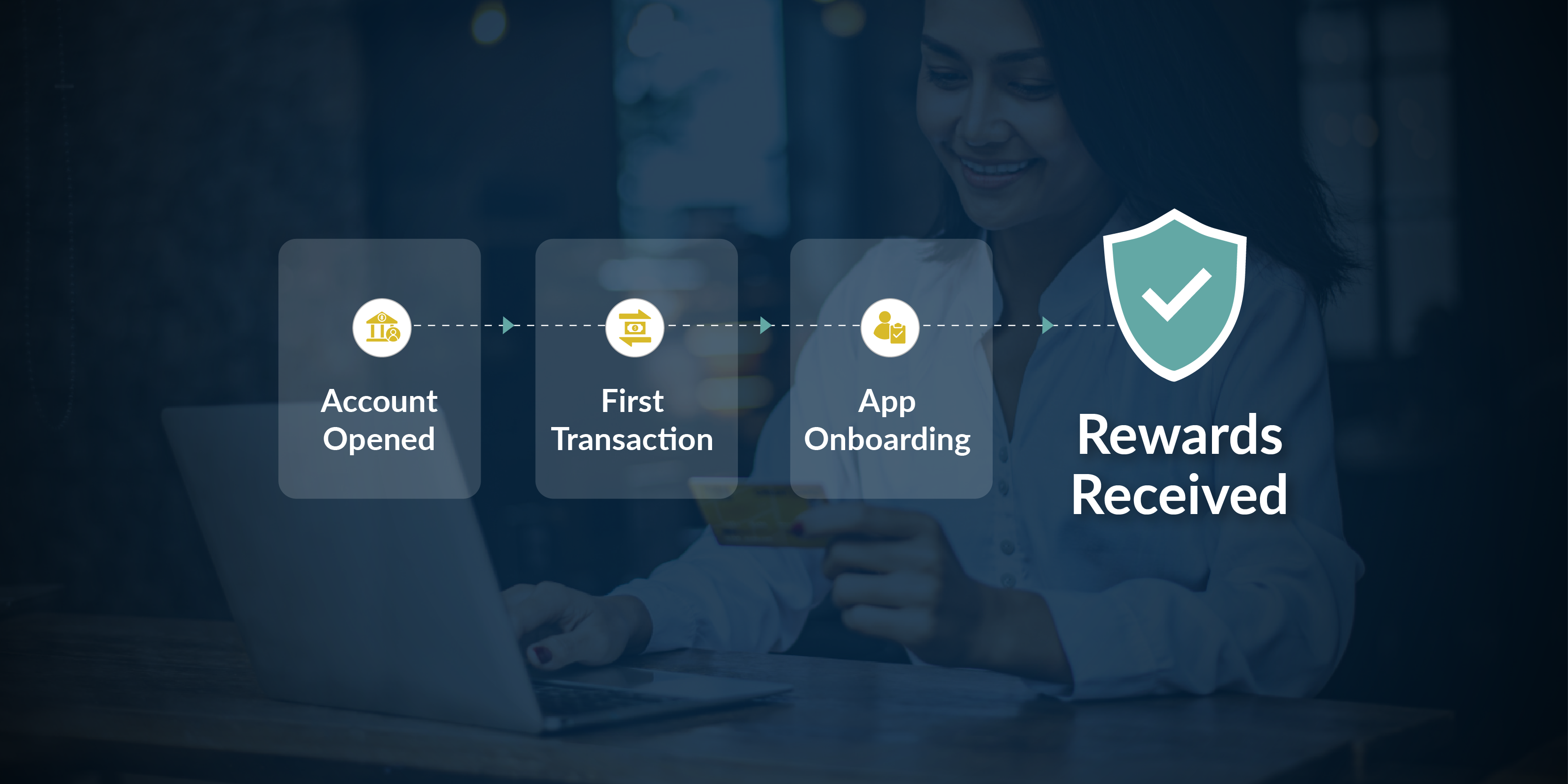
A successful rewards programme encourages customers to progress through a series of valuable banking behaviours rather than rewarding isolated transactions. Marketing Leaders should think of activation as a journey, with each interaction building confidence, trust, and engagement.
A practical activation framework includes four stages:
According to Deloitte, banks that personalise customer journeys across channels improve engagement because communications remain relevant to individual needs rather than relying on broad promotional campaigns. A structured rewards journey also enables marketers to measure progression between stages and optimise campaigns continuously.
The most effective activation journeys reward momentum instead of simply rewarding spend. Customers should clearly understand what action unlocks the next benefit. This visibility encourages repeat engagement while creating positive reinforcement throughout the customer lifecycle.
How Does Personalisation Improve Customer Activation Rates?
Customers ignore generic offers because they rarely reflect their financial goals or recent behaviour. Personalised rewards solve this challenge by delivering incentives based on customer activity, preferences, product ownership, and engagement history.
McKinsey reports that companies excelling at personalisation generate faster revenue growth and stronger customer loyalty than organisations relying on mass marketing. Personalisation also improves marketing efficiency by reducing irrelevant communications and increasing response rates.
Marketing Leaders should segment customers using factors such as:
- New versus existing customers.
- Active versus dormant customers.
- Digital-first versus branch-first users.
- Product mix.
- Transaction frequency.
- Customer lifetime value.
Each segment should receive different activation journeys. For example, a dormant customer may receive an incentive to complete a first transaction after several inactive weeks, while an active customer could earn additional rewards for adopting another banking product.
Personalisation also extends to reward choice. Some customers may value hotel bookings or flight bookings, while others prefer dining vouchers, merchandise, experiential rewards, or gift cards from over 5,000 brands. Providing meaningful redemption options increases the perceived value of the rewards programme and encourages continued participation.
How Can Rekyndl Automate Customer Activation Journeys?
Managing customer activation manually becomes increasingly difficult as customer volumes grow. Marketing Leaders need automation that combines customer data, behavioural triggers, campaign management, and reward fulfilment within a single workflow.
Rekyndl supports this approach by enabling banks and financial institutions to create personalised customer journeys based on real-time behaviour. Instead of relying on scheduled email campaigns alone, marketers can automate communications whenever customers complete specific actions or become inactive.
An automated activation journey can include:
- Customer onboarding.
- Welcome communications.
- Behaviour-based reward triggers.
- Personalised campaign journeys.
- Loyalty point allocation.
- Redemption through an integrated reward catalogue.
- Re-engagement campaigns for dormant customers.
- Performance dashboards and campaign analytics.
Forrester's research on customer experience consistently shows that organisations delivering relevant, connected experiences achieve stronger customer loyalty than those relying on disconnected marketing activities. Automation helps maintain consistency across every customer interaction while reducing operational effort.
Rekyndl combines marketing automation with an integrated rewards ecosystem that includes gift cards from over 5,000 brands, flight bookings, hotel bookings, dining experiences, sports experiences, merchandise, concierge services, and more. This enables Marketing Leaders to deliver personalised rewards that match customer preferences without increasing campaign complexity.
Frequently Asked Questions
How do rewards activate dormant bank customers?
Rewards encourage customers to return by creating immediate value for completing meaningful banking activities such as making a transaction, logging into digital banking, or setting up recurring payments. Behaviour-based incentives are generally more effective than broad promotional campaigns because they recognise individual customer actions.
What trigger events work best for bank customer activation?
The strongest trigger events include first deposits, first debit card transactions, mobile banking activation, recurring payment setup, savings milestones, product upgrades, referrals, and inactivity recovery campaigns. These behaviours indicate growing engagement and often predict long-term customer value.
What is a good customer activation rate?
Activation rates vary depending on the product and customer segment. Rather than measuring account openings alone, Marketing Leaders should monitor meaningful behaviours such as first transaction rates, digital banking adoption, repeat transaction frequency, and product usage within the first 30 to 90 days.
Can Rekyndl automate customer activation campaigns?
Yes. Rekyndl enables banks to automate personalised customer activation journeys using behavioural triggers, customer segmentation, loyalty rewards, marketing automation, and an integrated redemption platform. This reduces manual campaign management while improving customer engagement across the lifecycle.
Why should banks personalise rewards instead of offering the same incentive to everyone?
Customers respond more positively when rewards reflect their preferences and recent behaviour. Personalised rewards improve redemption rates, strengthen engagement, and help banks allocate marketing budgets more efficiently by rewarding the behaviours that support long-term customer relationships.
Conclusion
Customer activation is one of the most important drivers of long-term banking profitability. Rewards programmes deliver the greatest impact when they encourage meaningful customer behaviours, personalise every interaction, and guide customers through a structured activation journey. Marketing Leaders who combine behavioural insights, marketing automation, and relevant rewards can improve engagement while strengthening customer loyalty throughout the lifecycle. As customer expectations continue to evolve, intelligent activation programmes will become a defining advantage for banks and fintech organisations seeking sustainable growth.
See how Rekyndl helps banks automate personalised customer activation journeys, behavioural rewards, and loyalty campaigns through one integrated platform.
Sign up for our newsletter for trending top content!


