
How Banks Can Design Branch-Level Sales Incentive Programmes That Drive Cross-Sell Without Compliance Risk

Sign up for our newsletter for trending top content!
Introduction
Retail banking still relies heavily on branch networks for complex financial conversations, yet incentive design remains one of the most scrutinised areas of banking conduct. McKinsey estimates that effective cross-selling can increase customer profitability significantly, but regulators across major markets continue to penalise banks when sales incentives encourage unsuitable product recommendations. The challenge is not whether banks should incentivise cross-sell and upsell activity; it is how they can do so without creating mis-selling risk.
For Sales Leaders in BFSI and fintech organisations, the stakes are substantial. Poorly designed branch incentive programmes can trigger customer complaints, remediation costs, reputational damage, and regulatory intervention. Well-designed programmes can improve wallet share, deepen customer relationships, and increase branch productivity while strengthening governance. This article outlines a practical framework for building branch-level incentive programmes that reward appropriate customer outcomes, maintain transparency, and create a defensible compliance audit trail.
Why Bank Branch Sales Incentives Have a History of Creating Mis-selling Problems
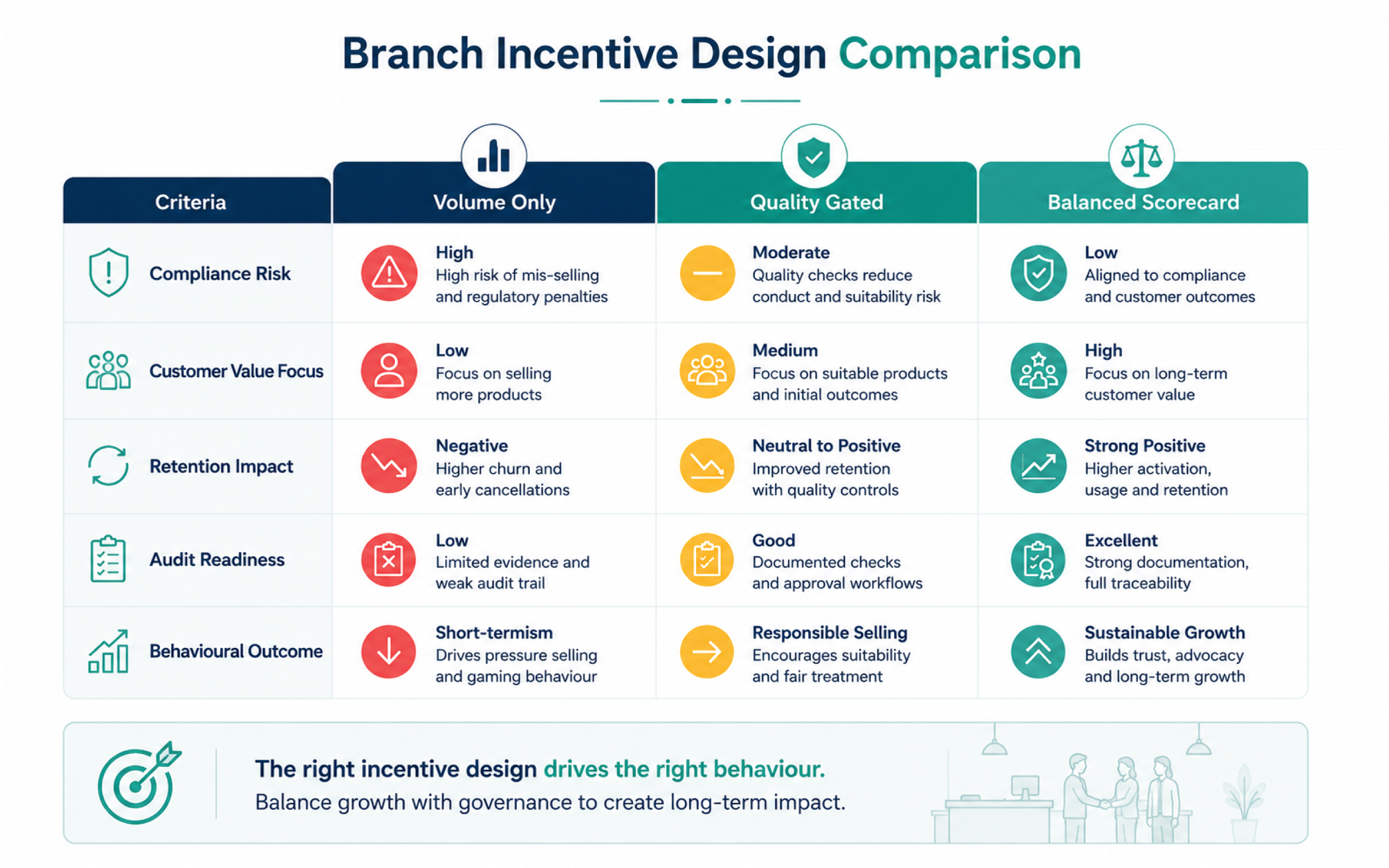
Banks have long used branch sales targets to encourage product penetration, but history shows that aggressive volume-based incentives can distort behaviour. The Financial Stability Board and banking regulators in multiple jurisdictions have repeatedly highlighted remuneration structures as a root cause of mis-selling episodes. Deloitte’s banking conduct research notes that incentives tied primarily to product volume increase the risk of staff prioritising sales outcomes over customer suitability.
The problem becomes more acute when frontline employees face individual monthly targets with limited visibility into customer lifetime value. Gartner’s research on sales performance management shows that narrow activity metrics often drive short-term behaviour rather than sustainable customer outcomes. In banking, this can translate into unsuitable insurance sales, unnecessary account add-ons, or pressure selling during routine branch visits.
The three common failure points
- Volume-only targets: Staff receive rewards for the number of products sold, regardless of suitability.
- Individual ranking pressure: Leaderboards focus solely on personal sales performance.
- Weak post-sale monitoring: Banks fail to track complaints, cancellations, or early product attrition.
Bain & Company has consistently found that customer advocacy and long-term relationship value correlate more strongly with retention and appropriate product usage than with short-term sales spikes. Sales Leaders should therefore treat incentive design as a conduct and customer-outcome mechanism, not merely a revenue tool. The objective is to encourage branch staff to identify genuine customer needs and recommend relevant products within a controlled governance framework.
Designing Product-Specific Incentives That Reward Appropriate Matching, Not Just Volume
A compliant bank branch sales incentive programme cross-sell upsell model should reward customer-product fit rather than raw sales volume. McKinsey’s retail banking research indicates that banks achieve more sustainable cross-sell growth when they use customer analytics and suitability indicators to guide sales conversations.
One effective approach is to allocate incentive points only after a product passes predefined quality checks, such as documented need assessment, eligibility verification, cooling-off completion where applicable, and a minimum active period.
Recommended incentive design framework
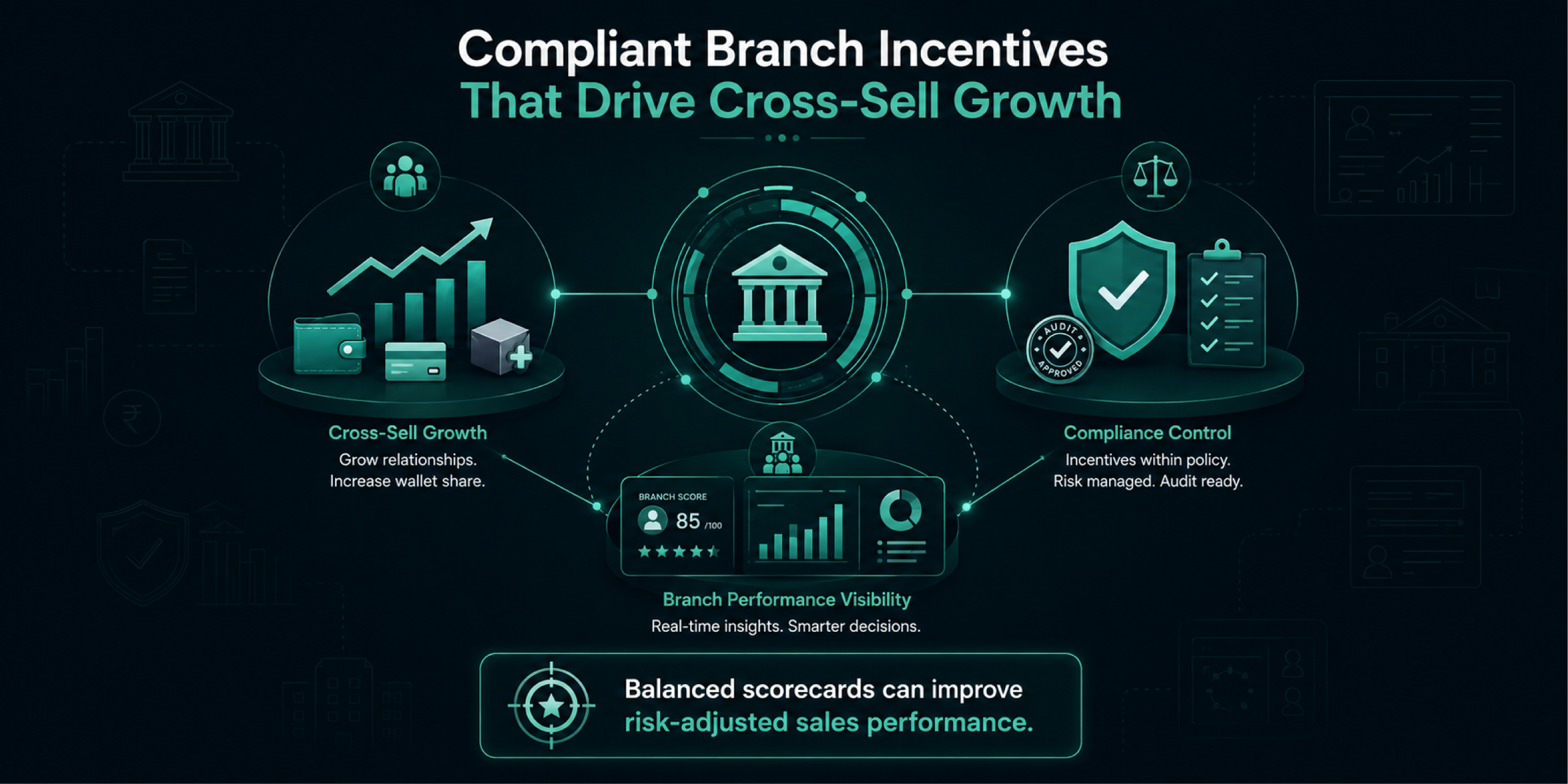
Mercer’s sales compensation studies show that balanced scorecards improve risk-adjusted sales performance by reducing overemphasis on a single metric. A practical branch scorecard might weight product suitability at 40%, customer retention at 30%, compliance quality at 20%, and sales growth at 10%.
This is where a structured incentive management platform becomes valuable. Paytives for BFSI and fintech organisations allows banks to configure product-level rules, quality gates, approval workflows, and payout conditions before incentives are released. The platform can support multi-currency payouts and complex banking product structures while maintaining governance controls.
Banks should also link cross-sell rewards to customer relationship depth, such as active salary accounts, recurring transactions, or ongoing product usage, rather than one-time product acquisition alone.
How to Run Branch Team Incentives Without Creating Individual Sales Pressure
Team incentives can reduce the harmful effects of individual sales pressure, but only if banks design them carefully. Gallup’s workplace research shows that employees perform better when they feel part of a supportive team rather than competing constantly against colleagues. In branch banking, collaboration matters because customer servicing, operations, and relationship management often involve multiple staff members.
A branch-level incentive pool can encourage collective responsibility for customer experience and compliance. However, Sales Leaders should avoid equal distribution regardless of contribution, as this may create free-rider behaviour.
A balanced branch team model
- 60% branch outcome metrics: customer satisfaction, complaint rates, audit scores, and overall branch growth.
- 40% role-based contribution metrics: referrals completed, service quality, onboarding accuracy, and customer follow-up completion.
Deloitte’s research on incentive governance suggests that mixed team-and-individual structures produce stronger conduct outcomes than purely individual sales commissions. The key is to recognise collaborative behaviours that support suitable sales, such as successful hand-offs between tellers, relationship managers, and specialist advisers.
Banks can further reduce pressure by setting quarterly rather than monthly branch targets for complex products. This gives staff more time to assess customer needs properly. Recognition mechanisms also matter. Non-cash recognition, peer appreciation, and milestone awards can reinforce desired behaviours without creating excessive sales urgency. For banks exploring broader recognition strategies, The Reward Store’s employee recognition platform provides additional context on reinforcing compliant performance cultures: https://www.therewardstore.com/applaudiq.
The strongest branch cultures celebrate customer trust indicators alongside sales achievements.
Digital Incentive Transparency: Why Branch Staff Performance Dashboards Change Behaviour
Transparency changes behaviour. When branch employees can see how incentives are calculated, which quality checks remain pending, and how compliance metrics affect payouts, they make more informed decisions. Gartner’s sales technology research has found that real-time performance visibility improves sales execution and reduces disputes about compensation.
Traditional spreadsheet-based incentive processes often suffer from delayed updates, manual errors, and limited auditability. Staff may not know whether a sale qualifies until weeks later, which weakens the behavioural link between action and reward.
What an effective dashboard should display
- Eligible sales versus pending validation.
- Compliance exceptions requiring action.
- Customer retention or activation status.
- Branch performance against target ranges.
- Incentive earnings by product category.
- Quality score trends over time.
Forrester’s research on employee experience technology shows that transparent performance systems increase trust in organisational processes and reduce perceptions of unfairness. In banking, this trust is critical because perceived opacity can encourage gaming behaviour or disputes.
A digital incentive platform such as Paytives can provide real-time branch and regional dashboards, automated rule validation, and exception alerts. Managers can identify unusual sales patterns early, such as sudden spikes in a single product category, and investigate before payouts occur.
Sales Leaders should also use dashboards as coaching tools, not surveillance tools. Managers who discuss quality metrics, customer outcomes, and compliance trends in regular branch reviews create a learning environment rather than a punitive one.
Multi-Product Incentive Management: How to Run Savings, Loans, and Insurance Incentives Without Confusion
Most branch networks sell multiple product families simultaneously. Confusion arises when each product line has different targets, payout timings, eligibility rules, and approval processes. Mercer’s incentive administration research shows that complexity is one of the biggest predictors of payout errors and employee dissatisfaction.
The solution is a unified incentive architecture with consistent principles across products.
A practical multi-product framework
This structure allows staff to understand that every product follows the same governance philosophy: sales qualify only when customer suitability and post-sale quality criteria are met.
Centralised incentive management becomes especially important for regional or national branch networks. Paytives enables banks to manage multiple product schemes within a single rules engine, apply role-based eligibility, and automate payout calculations across branches and countries. This reduces administrative burden and helps Sales Leaders maintain policy consistency.
Banks should also publish a single incentive handbook that explains calculation logic, escalation paths, clawback conditions, and compliance expectations in plain language. Clarity is a control mechanism.
For additional insight into incentive strategy design, see The Reward Store’s channel incentive resources: https://www.therewardstore.com/paytives.
The Compliance Audit Trail: What Banks Need to Demonstrate Incentive Programme Integrity to Regulators
Regulators increasingly expect banks to prove that incentive programmes support fair customer outcomes. A defensible audit trail is therefore as important as the incentive design itself. Deloitte’s conduct risk framework emphasises that organisations must be able to evidence governance, monitoring, remediation, and accountability.
Minimum audit evidence
- Approved incentive policy and governance committee records.
- Product eligibility and suitability criteria.
- Staff acknowledgement of incentive rules.
- Timestamped sales and approval records.
- Compliance review outcomes.
- Complaint and cancellation linkage analysis.
- Clawback actions and remediation history.
- Manager override approvals with rationale.
A robust audit trail allows banks to demonstrate that they identified risks, applied controls, monitored outcomes, and corrected issues promptly. Forrester’s governance research highlights that automated recordkeeping significantly reduces the time required for regulatory reviews and internal audits.
Sales Leaders should conduct quarterly incentive risk reviews with compliance, HR, and internal audit teams. Key indicators include complaint rates by product, early cancellation rates, concentration of sales among top performers, and branch-level variance patterns.
Technology plays a critical role here. Paytives maintains rule histories, approval workflows, payout records, and performance logs, creating a searchable audit repository that supports internal governance and regulatory examination. The goal is not simply to store data; it is to show a clear chain of decision-making from incentive policy to customer outcome.
Banks that can demonstrate this chain are far better positioned during regulatory inspections and conduct reviews.
Frequently Asked Questions
What is a compliant bank branch sales incentive programme for cross-sell and upsell activity?
A compliant programme rewards suitable customer outcomes rather than raw product volume. It includes documented needs assessment, eligibility checks, quality validation, and ongoing monitoring. Banks should combine sales metrics with compliance, retention, and customer satisfaction indicators. This reduces mis-selling risk while still encouraging relationship growth.
How should banks measure cross-sell performance at branch level?
Banks should measure active multi-product relationships, retention after 90 days, customer satisfaction, complaint rates, and quality review outcomes. Product count alone is insufficient because it does not reflect suitability or long-term value. A balanced scorecard provides a more accurate picture of branch performance.
Why do team incentives create lower conduct risk than individual sales targets?
Team incentives encourage collaboration and shared responsibility for customer outcomes. When staff succeed collectively, they are less likely to pressure customers to meet personal quotas. Gallup’s research shows that strong team environments improve engagement and reduce counterproductive competition. Banks should still include role-based contribution metrics to maintain accountability.
Can Paytives manage incentives for savings, loans, insurance, and investment products together?
Yes. Paytives supports multi-product incentive management through a unified rules engine, role-based eligibility, automated calculations, approval workflows, and real-time dashboards. Banks can apply different quality controls to each product category while maintaining a consistent governance framework across the branch network.
How often should banks review branch incentive schemes for compliance risk?
Banks should conduct formal reviews at least quarterly and perform continuous monitoring of key risk indicators. Reviews should involve Sales, Compliance, HR, and Internal Audit teams. Trigger-based reviews should occur sooner if complaint rates rise, sales patterns change significantly, or regulators issue new guidance.
Conclusion
Banks do not need to choose between cross-sell growth and compliance integrity. The most effective branch incentive programmes reward appropriate customer matching, make performance transparent, simplify multi-product administration, and maintain a complete audit trail. Sales Leaders who treat incentives as a customer-outcome system rather than a pure sales mechanism can improve branch productivity while reducing conduct risk.
As banking becomes more data-driven, regulators will expect even greater evidence of incentive governance and customer fairness. The banks that build transparent, technology-enabled incentive frameworks now will be better positioned for both growth and scrutiny.
See how Paytives helps banks run compliant branch sales incentives: https://www.therewardstore.com/paytives/solutions/bfsi-fintech
Sign up for our newsletter for trending top content!


