
How Automotive OEMs Can Use Dealer Incentive Programmes to Drive Sell-Through and Accessories Revenue

Sign up for our newsletter for trending top content!
Introduction
Dealerships generate a significant share of their profitability from accessories and aftersales services rather than vehicle sales alone. According to NADA, fixed operations and related services often contribute a disproportionate share of dealership profits compared to new vehicle margins. Yet many automotive OEMs still structure dealer incentives almost entirely around wholesale volumes.
This approach creates a costly disconnect. Vehicles may move into dealer inventory, but sell-through slows, accessory attachment rates remain low, and aftersales opportunities go unrealised. Sales leaders face increasing pressure to improve retail performance without simply increasing incentive spend.
This article explores how automotive OEMs can redesign dealer incentive programmes to drive genuine sell-through, increase accessories revenue, improve visibility across dealer networks, and create more predictable performance. It also examines how modern incentive management platforms help OEMs manage multiple programmes simultaneously while giving regional teams the intelligence they need to act before quarter-end.
Why Most Automotive Dealer Incentive Schemes Fail to Drive Genuine Sell-Through
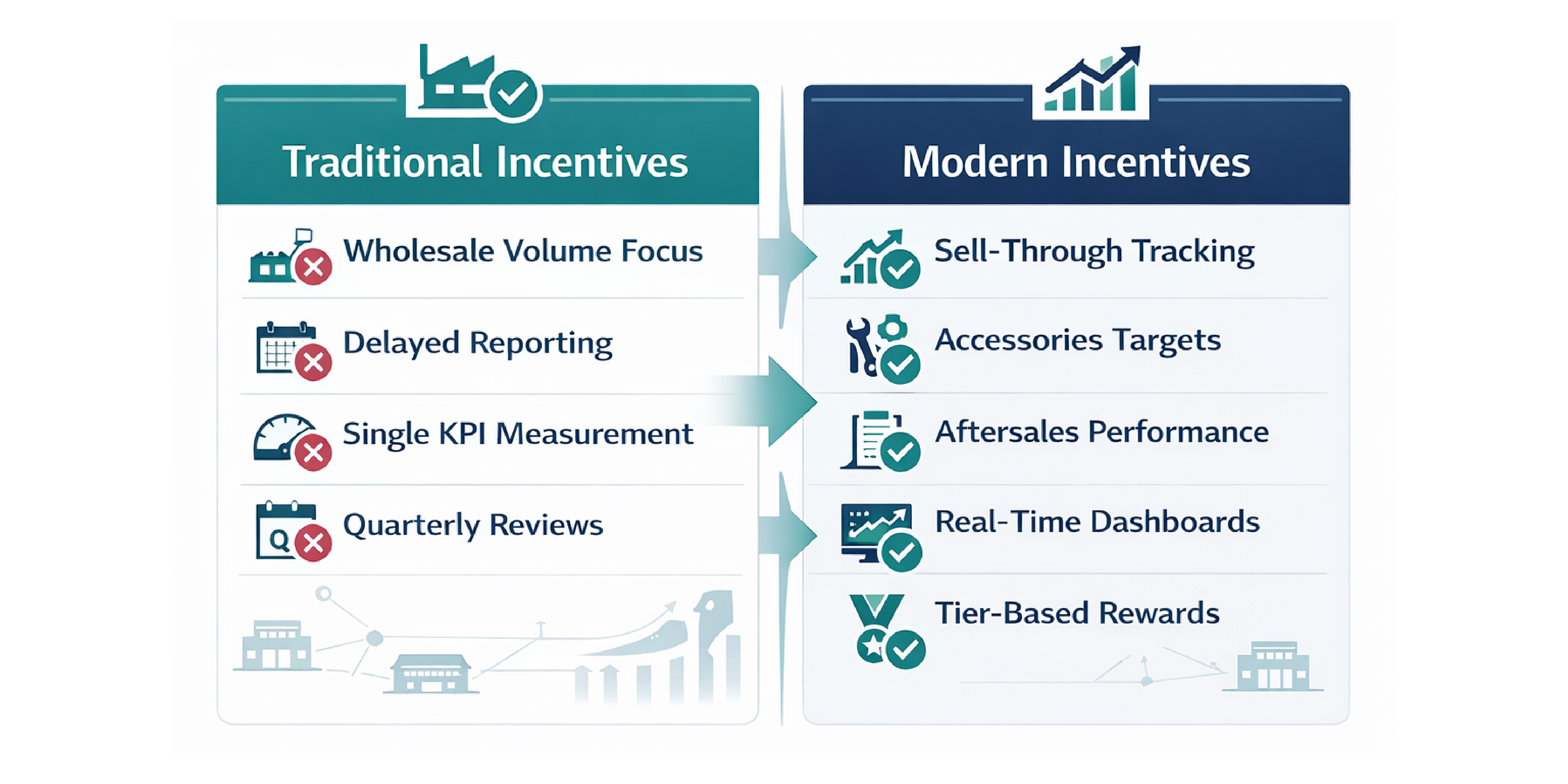
Many automotive incentive schemes reward shipments rather than outcomes. Dealers receive incentives for vehicle purchases from OEMs, while the actual retail sale receives far less attention. This structure can create inventory build-up instead of customer demand.
Research from McKinsey has repeatedly highlighted the importance of aligning incentives with customer-facing outcomes rather than intermediate metrics. When organisations reward activity rather than results, performance often plateaus despite increased programme expenditure.
Three common issues typically undermine automotive dealer incentive programme management:
Incentives Focus on Wholesale Rather Than Retail
OEMs frequently reward dealer stock purchases. Dealers may qualify for targets before vehicles reach end customers. This approach can distort demand signals and create channel inventory challenges.
Short-Term Campaigns Encourage Tactical Behaviour
The Incentive Research Foundation (IRF) has found that incentive design significantly influences participant behaviour. Short-term volume bonuses often encourage end-of-quarter spikes rather than sustained performance throughout the year.
Limited Visibility Reduces Engagement
Dealers who cannot track progress in real time often disengage from programmes. Gartner research consistently shows that visibility and transparency improve participation rates across performance-based initiatives.
The result is predictable. OEMs increase programme budgets while sell-through rates, accessory penetration, and customer retention remain largely unchanged. Effective incentive strategies must connect rewards directly to retail outcomes and long-term dealer performance.
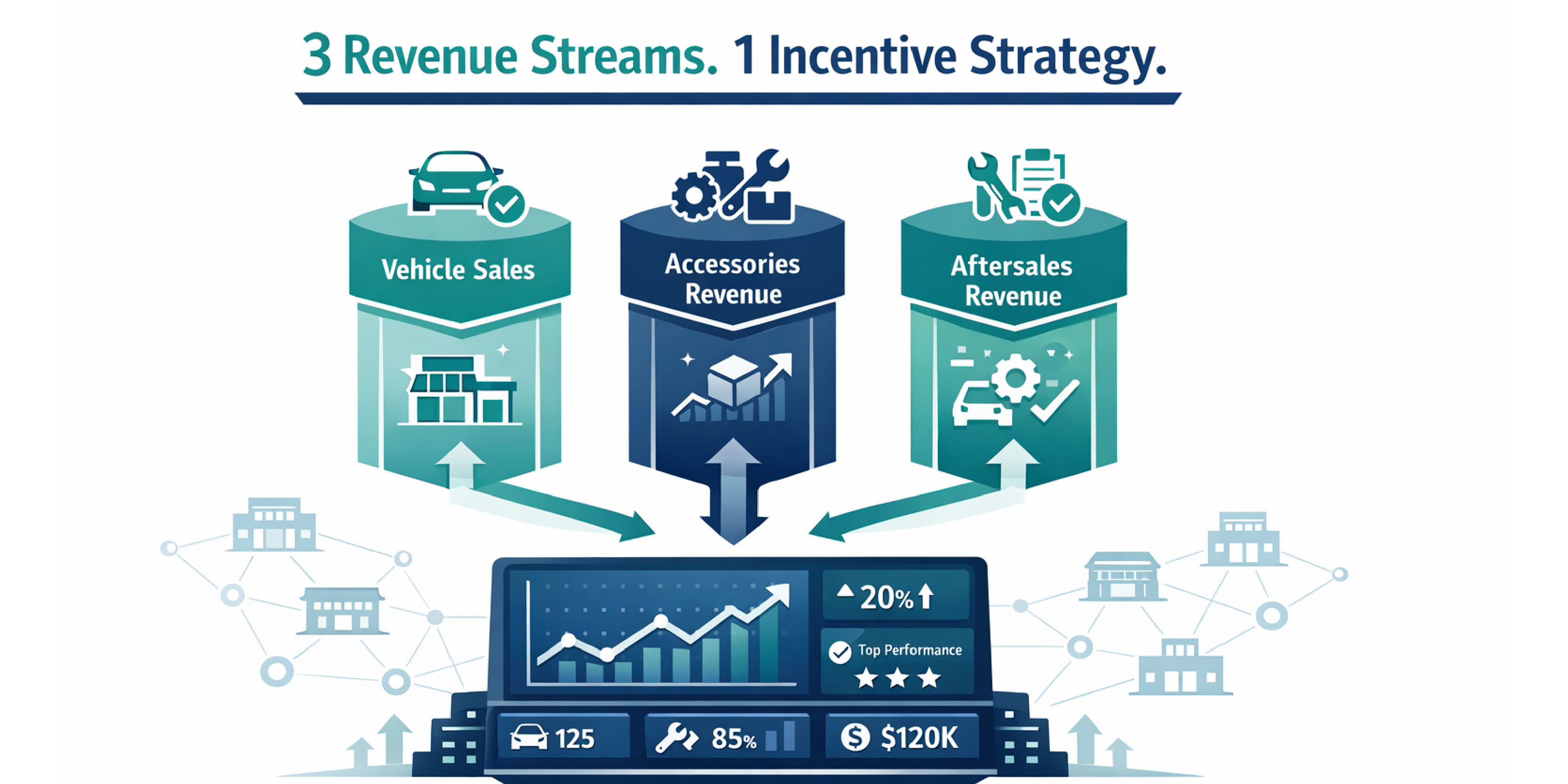
The Three Revenue Streams Dealer Incentives Should Cover and Usually Don't
Most dealer incentive schemes focus on one metric: vehicle volume. Yet automotive profitability depends on multiple revenue streams.
A more effective framework aligns incentives with the three areas that influence dealer and OEM profitability most directly.
According to Deloitte, aftersales operations can contribute a substantial portion of long-term automotive profitability. Bain & Company has similarly highlighted that customer retention generates significantly higher lifetime value than acquisition alone.
Vehicle Sell-Through
Rewarding actual retail sales creates stronger alignment between OEM objectives and dealer behaviour. It encourages dealers to focus on customer conversion rather than inventory accumulation.
Accessories Revenue
Accessories often represent one of the fastest paths to increasing transaction value. Programmes that reward attachment rates, accessory bundles, or category-specific targets can drive measurable revenue growth.
Aftersales Performance
Service bookings, maintenance plans, and customer retention programmes create recurring revenue opportunities. Yet many OEM incentive structures exclude these activities entirely.
This is where Paytives supports automotive OEMs. The platform allows organisations to manage multiple performance metrics within a single programme structure, ensuring dealers receive recognition for the full spectrum of revenue-generating activities rather than vehicle volume alone.
How to Design Tier-Based Dealer Incentives That Reward Consistent Performance Not Just Peaks
Many automotive incentive programmes over-reward exceptional short-term performance while neglecting consistent execution.
Research from the Incentive Research Foundation suggests that tiered incentive structures often sustain engagement more effectively than winner-takes-all models. Participants remain motivated because achievable milestones exist throughout the programme lifecycle.
A Practical Tier Framework
Bronze Tier
- Achieve baseline monthly retail targets
- Earn foundational rewards
Silver Tier
- Exceed sell-through targets
- Meet accessory attachment benchmarks
Gold Tier
- Deliver sustained quarterly growth
- Achieve aftersales and customer retention objectives
Platinum Tier
- Consistently outperform across all categories
- Maintain top customer experience scores
This approach creates several advantages.
First, more dealers participate because rewards remain attainable. Second, performance becomes more predictable across the quarter. Third, OEMs encourage balanced growth instead of isolated volume spikes.
Mercer research has shown that structured recognition and incentive frameworks improve sustained behavioural change compared with one-time rewards.
The most effective programmes also combine financial rewards with status recognition. Leaderboards, achievement badges, and exclusive programme benefits can reinforce motivation without significantly increasing incentive budgets.
Sales leaders should evaluate incentive designs using a simple question: does the programme reward one exceptional month or twelve months of reliable execution? The latter almost always produces stronger long-term channel performance.
Real-Time Dealer Dashboards: What Visibility Does to Dealer Motivation
Dealer motivation often declines when performance data arrives too late to influence behaviour.
Forrester research has consistently identified visibility as a key driver of engagement within partner ecosystems. Participants perform better when they understand current progress, remaining gaps, and achievable next milestones.
Why Real-Time Visibility Matters
Dealers respond to immediate feedback. Quarterly spreadsheets and delayed reports fail to create urgency.
Real-time dashboards help dealers:
- Monitor target achievement
- Track incentive earnings
- Compare performance against peers
- Identify gaps before programme deadlines
- Prioritise high-value opportunities
The Psychological Impact of Progress Tracking
Behavioural research from Gartner indicates that visible progress increases participant engagement. When individuals see measurable advancement toward goals, they are more likely to maintain effort.
For automotive networks, this visibility becomes especially important when multiple programmes operate simultaneously.
Using Paytives, OEMs can provide dealers with a consolidated performance view across vehicle sales, accessories, service targets, and incentive earnings. Rather than waiting until month-end reports arrive, dealers can make adjustments immediately.
The result is stronger programme participation, improved accountability, and faster performance correction. For sales leaders, this visibility creates greater confidence that incentive investment is driving the behaviours the organisation intends to reward.
Managing Concurrent Volume, Accessories, and Aftersales Programmes Without Admin Overload
As dealer networks grow, programme complexity increases rapidly.
A typical automotive OEM may run:
- Quarterly volume incentives
- Seasonal accessories campaigns
- Service retention initiatives
- Regional performance contests
- New model launch programmes
Without centralised management, administration becomes difficult to scale.
According to Aberdeen Group, organisations that automate incentive processes achieve significantly greater operational efficiency than those relying on manual programme management.
Common Administrative Challenges
- Multiple spreadsheets across regions
- Inconsistent performance calculations
- Delayed payouts
- Disputes regarding eligibility
- Limited programme visibility
These challenges create friction for both dealers and OEM teams.
Centralising Incentive Operations
Modern dealer incentive programme management platforms consolidate programme creation, performance tracking, reward calculation, and payout execution within a single environment.
Instead of managing separate systems for each initiative, sales leaders can oversee all dealer programmes from one dashboard.
This consolidation reduces administrative workload while improving accuracy. It also enables faster programme launches, easier rule changes, and more consistent dealer experiences.
As automotive distribution models evolve, programme agility will become increasingly important. OEMs that simplify incentive administration gain more time to focus on strategy, dealer development, and revenue growth.
How to Give Regional Sales Managers the Channel Intelligence They Need to Act In-Quarter
Regional Sales Managers play a critical role in dealer performance. Yet many operate with outdated information.
By the time traditional reports highlight underperforming dealerships, opportunities for corrective action have often disappeared.
McKinsey research emphasises the importance of data-driven decision-making in sales organisations. Teams that access timely performance insights typically respond faster to emerging risks and opportunities.
What Regional Managers Need to See
Effective channel intelligence includes:
- Dealer ranking and progression
- Sell-through performance trends
- Accessory attachment rates
- Aftersales achievement metrics
- Incentive qualification status
- Regional performance comparisons
Acting Before the Quarter Ends
The greatest value comes from intervention, not reporting.
When managers identify performance gaps early, they can:
- Conduct targeted dealer coaching
- Reallocate resources
- Launch tactical campaigns
- Promote specific accessory categories
- Address regional demand fluctuations
Paytives enables regional teams to access real-time channel intelligence through role-based dashboards and automated reporting. This visibility allows managers to focus attention where it creates the greatest impact.
The difference is substantial. Instead of explaining missed targets after the quarter closes, managers can influence outcomes while time remains to improve performance.
Frequently Asked Questions
What is automotive dealer incentive programme management?
Automotive dealer incentive programme management refers to the design, administration, tracking, and optimisation of incentives that encourage dealer performance. These programmes typically reward vehicle sales, accessories revenue, aftersales performance, or customer retention activities. Effective management ensures incentives align with business objectives and dealer behaviour.
How can dealer incentives increase accessories revenue?
Dealer incentives can reward accessory attachment rates, bundled product sales, or category-specific targets. When dealers receive recognition and rewards for selling accessories, they focus more consistently on upselling opportunities. This increases average transaction value and overall profitability.
Why do many automotive dealer incentive programmes fail?
Many programmes focus heavily on wholesale vehicle shipments rather than retail outcomes. Others lack transparency, provide delayed reporting, or reward short-term spikes instead of sustained performance. Research from McKinsey and the Incentive Research Foundation suggests that incentive alignment and visibility significantly influence effectiveness.
When should OEMs introduce tier-based incentive structures?
OEMs should consider tier-based programmes when they want to encourage broader participation and long-term performance improvement. Tier structures provide achievable milestones for more dealers while maintaining aspirational goals for top performers. This often creates stronger engagement across the network.
Can Paytives manage multiple dealer incentive programmes simultaneously?
Yes. Paytives allows automotive OEMs to manage volume incentives, accessories campaigns, aftersales initiatives, and regional performance programmes within a single platform. This reduces administrative complexity while providing dealers and sales leaders with unified performance visibility.
Conclusion
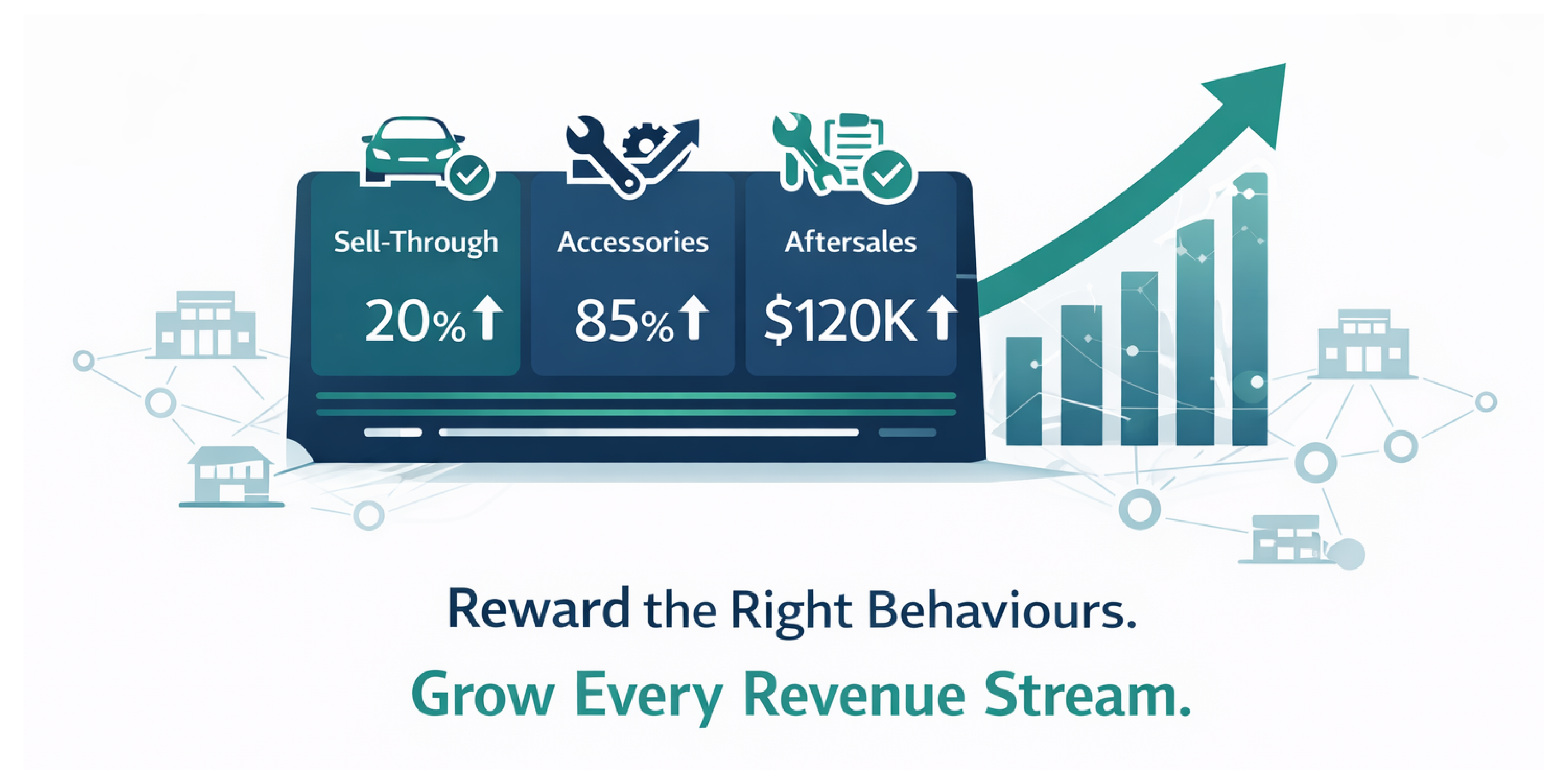
Automotive OEMs achieve stronger results when dealer incentives reward retail outcomes rather than wholesale activity alone. The most effective programmes align rewards across vehicle sales, accessories revenue, and aftersales performance while giving dealers and regional teams real-time visibility into progress.
As automotive distribution becomes increasingly data-driven, incentive programmes will evolve from quarterly reward mechanisms into continuous performance management systems. OEMs that modernise incentive management today will be better positioned to drive sustainable channel growth tomorrow.
See how Paytives powers dealer incentive programmes for automotive OEMs
Explore automotive incentive programme management solutions from Paytives
Sign up for our newsletter for trending top content!


