
How Airlines and Travel Brands Can Build Loyalty Programmes That Move Beyond Miles and Drive True Behavioural Engagement

Sign up for our newsletter for trending top content!
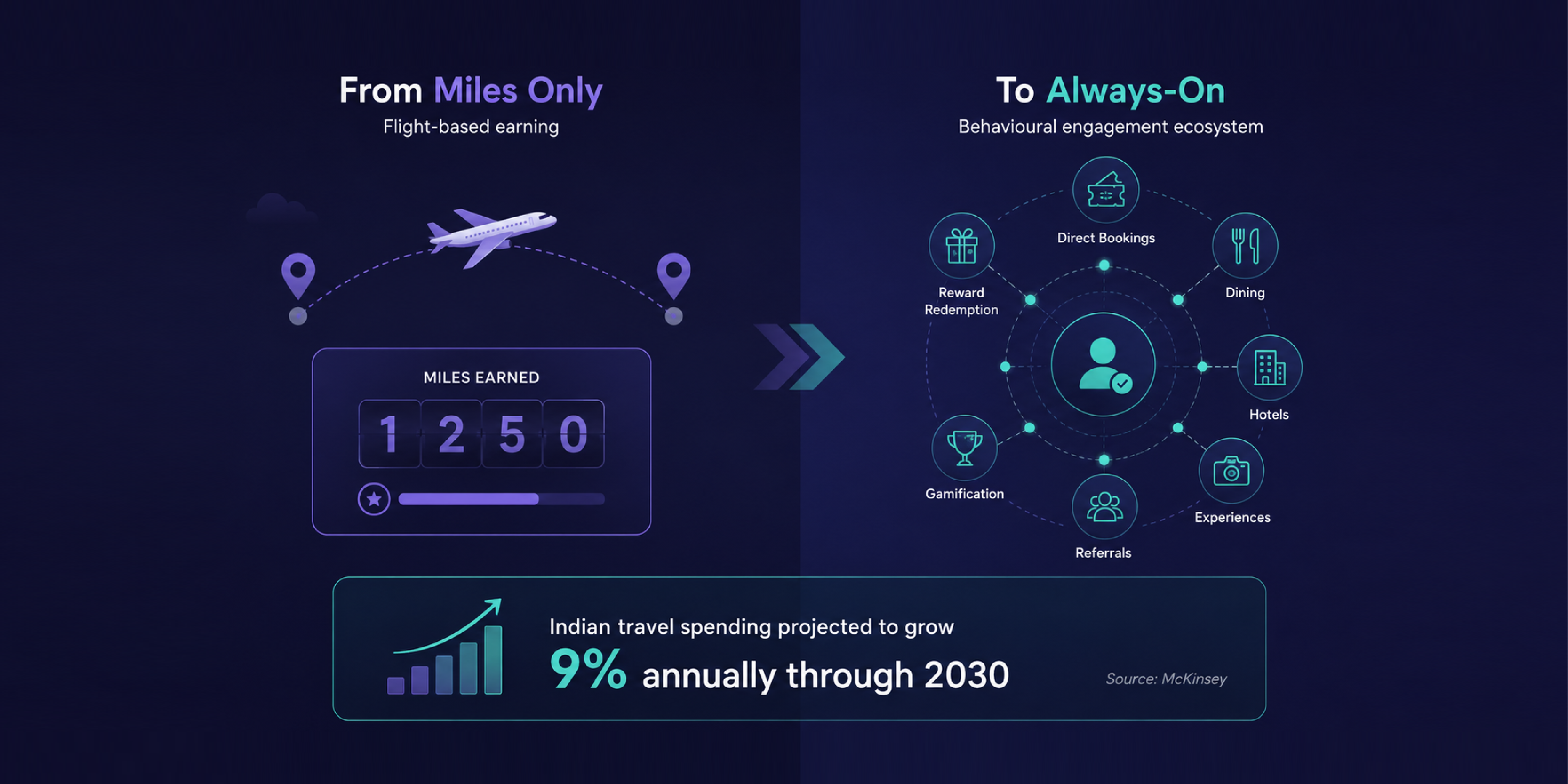
India is becoming one of the world's most important travel growth markets. McKinsey projects that Indian travel spending will grow by 9% annually through 2030, creating a significant opportunity for airlines and travel brands to win long-term customer value.
Yet traditional frequent flyer models often concentrate value around one behaviour: flying. That creates an engagement gap between journeys, particularly among younger travellers whose expectations increasingly centre on digital convenience, personal relevance and memorable experiences. Deloitte identifies younger, technology-oriented generations as a major force reshaping travel demand, while McKinsey reports that 52% of Gen Z consumers splurge on experiences.
For Marketing Leaders, the opportunity is clear. An effective airline loyalty programme must evolve from a mileage ledger into an always-on behavioural engagement ecosystem that influences discovery, booking, ancillary spending, advocacy and repeat travel.
Why Frequent Flyer Programmes Are Losing Relevance With India's Next Generation of Travellers
Frequent flyer programmes were designed around a straightforward exchange: fly more, accumulate more miles and eventually receive travel benefits. That model remains valuable for frequent travellers, but it becomes less effective when it serves as the entire engagement strategy.
India's growing travel market makes this limitation increasingly important. McKinsey expects Indian travel spending to grow by 9% annually through 2030. At the same time, younger customers are changing how travel decisions begin and how brands earn consideration. Deloitte's 2025 travel research found that more than half of surveyed Gen Z travellers used short-form social video for travel inspiration, illustrating how digital discovery now shapes the customer journey before a booking occurs.
A miles-only model can therefore overlook valuable behaviours that happen outside the aircraft. Customers research destinations, interact with content, book hotels, purchase experiences, refer friends and engage with offers long before their next flight.
McKinsey also notes that younger luxury travellers tend to value social experiences, authenticity, sustainability and digital connectedness. These preferences suggest that loyalty programmes need broader ways to recognise customer intent and participation, not simply transaction volume.
For Marketing Leaders, the strategic question should shift from "How many miles did this customer earn?" to "Which customer behaviours can we encourage throughout the complete travel lifecycle?"
That shift turns loyalty from a retrospective reward mechanism into an active growth channel.
Beyond Miles: The Experiential Rewards That Travel Customers Actually Value

The strongest travel rewards do more than reduce the cost of a future transaction. They make participation feel worthwhile now.
McKinsey found that 52% of Gen Z consumers say they splurge on experiences, compared with 29% of baby boomers. Its travel research also indicates that younger travellers may reduce spending elsewhere before cutting spending on experiences.
This has significant implications for airline and travel loyalty design. A programme that restricts perceived value to flight redemptions can miss the wider emotional context of travel.
A broader reward ecosystem can give members access to categories such as:
- Flight and hotel bookings.
- Dining vouchers and culinary experiences.
- Sports tickets and entertainment.
- Adventure and experiential rewards.
- Golf and leisure experiences.
- Merchandise and lifestyle rewards.
- Bus bookings and related travel services.
- Gift cards from 5,000+ brands.
- Concierge-led experiences.
The objective is not simply to add more catalogue items. Marketing Leaders should build reward choice around different traveller motivations.
A business traveller may prioritise convenience and flexibility. A family traveller may value accommodation and experiences. A younger leisure traveller may respond more strongly to memorable activities. A premium customer may place greater value on exclusivity and personalised service.
McKinsey's research into luxury travel reinforces this principle: modern travel value increasingly depends on understanding how customers want to feel and tailoring experiences accordingly.
The best loyalty currency therefore has two qualities: customers can earn it through meaningful behaviours, and they can redeem it for rewards that feel personally relevant.
How to Design Non-Flight Earning Opportunities That Keep Customers Engaged Between Journeys
The fundamental weakness of a flight-only earning model is frequency. Most customers do not fly every week, but brands can create valuable interactions throughout the periods between journeys.
Deloitte's global consumer loyalty research highlights the growing opportunity for brands to use customer data to create more meaningful connections through loyalty programmes. McKinsey's travel research similarly shows that discovery and experience preferences increasingly influence travel decisions beyond the booking transaction itself.
Marketing Leaders can design an earning framework around three categories:
This model gives the programme more opportunities to influence behaviour without simply increasing discounting.
For example, an airline could reward customers for completing preference profiles, booking directly, adding relevant travel services or participating in destination campaigns. A hotel group could recognise repeat stays, direct reservations, dining activity and selected engagement milestones.
Rekyndl supports this approach by combining loyalty programme design with segmentation, automated customer journeys, gamification and redemption capabilities. Marketing teams can create triggered journeys around welcome, birthdays, cart abandonment and win-back moments while rewarding the behaviours that matter commercially.
The result is a more active relationship between trips. Instead of waiting for the next flight to restart engagement, the loyalty programme creates relevant reasons for customers to return throughout the travel lifecycle.
Personalisation in Travel Loyalty: How Segment-Specific Journeys Outperform Generic Miles Statements
A monthly miles balance tells customers what they have. A personalised loyalty journey tells them what they can do next.
That distinction matters because travellers do not represent a single behavioural segment. McKinsey notes that the modern travel market includes multiple generations and traveller personas, with individual needs changing according to life stage, trip purpose and travelling companions. Its research also identifies authenticity, social experiences and digital connectedness among the priorities influencing younger travellers.
Marketing Leaders should therefore segment loyalty communication using behavioural and contextual signals rather than relying solely on membership tier.
A practical segmentation model could distinguish between frequent business travellers, occasional leisure travellers, family travellers, premium customers, dormant members and high-intent customers who browse without booking.
Each segment should receive a different next-best action.
A dormant member might receive a win-back journey built around accessible redemption options. A frequent traveller could receive relevant benefits linked to their established behaviour. A customer who abandons a booking could enter a time-sensitive recovery journey. A family traveller could receive recommendations aligned with accommodation and experience preferences.
Deloitte's loyalty research emphasises the increasing role of customer data in creating meaningful programme relationships, while its wider travel research identifies younger, digitally oriented consumers as a major force reshaping the industry.
The operational challenge is scale. Marketing teams cannot manually build every interaction. Platforms such as Rekyndl for Marketing Leaders help combine customer segmentation with automated journeys and multi-channel engagement, allowing loyalty communication to respond to customer behaviour rather than a fixed promotional calendar.
Partnership Redemption: How to Build a Reward Catalogue That Makes Points Feel Valuable Every Week
Points only create perceived value when customers believe they can use them for something worthwhile within a reasonable timeframe.
This makes redemption design as important as earning design. Deloitte's consumer loyalty research examines how programmes must evolve to create more meaningful consumer relationships, while McKinsey's experience research shows particularly strong appetite for experiential spending among younger consumers. Together, these findings support a broader loyalty model in which utility and relevance extend beyond a single core transaction.
For travel brands, a useful reward catalogue should balance four factors: accessibility, aspiration, relevance and choice.
Customers should have lower-threshold redemption options that make points feel usable without waiting years for a major reward. They should also have aspirational options that encourage continued participation. Categories should reflect different lifestyles and travel occasions, while sufficient choice helps avoid forcing every member into the same definition of value.
A partnership-led catalogue can include flight bookings, hotel bookings, dining vouchers, experiences, sports tickets, adventure activities, merchandise and gift cards from 5,000+ brands.
Marketing Leaders should also monitor the economics behind this choice. Redemption should encourage valuable behaviour without creating unsustainable programme costs. The relationship between earning speed, redemption accessibility and breakage requires active management.
For a deeper framework, see The Reward Store's guide to managing loyalty programme earn and burn ratios.
When customers can regularly see realistic uses for their points, loyalty currency becomes more tangible. That perceived utility can give members a stronger reason to remain active between major travel purchases.
Measuring Travel Loyalty ROI: Direct Booking Rate, Frequency Uplift, and Share of Wallet
A loyalty programme should not succeed because enrolment numbers are rising. It should succeed because customer behaviour is becoming more valuable.
For Marketing Leaders, that requires moving beyond membership totals and points issued.
McKinsey projects strong growth in Indian travel spending through 2030, but growth in the overall market does not guarantee that an individual airline or travel brand will capture a greater share of customer spending. Deloitte also warns that travel companies that fail to adapt to changing traveller expectations risk customer erosion and missed growth opportunities.
A stronger measurement framework should track:
- Direct booking rate: Are loyalty members increasingly booking through owned channels?
- Purchase frequency uplift: Do engaged members travel or transact more often than comparable non-engaged customers?
- Share of wallet: Is the programme capturing more of each customer's total travel and lifestyle spending?
- Redemption rate: Are members using their points rather than accumulating unusable balances?
- Active member rate: How many members have earned, redeemed or engaged within a defined period?
- Ancillary revenue: Does loyalty increase spending beyond the core booking?
- Reactivation rate: How effectively do automated journeys bring dormant customers back?
- Customer lifetime value: Does programme participation correlate with stronger long-term economics?
The key is to connect loyalty activity with incremental behaviour. Marketing Leaders should compare cohorts, track pre-enrolment and post-enrolment behaviour where possible, and measure campaign-level conversion.
This turns the airline loyalty programme from a cost centre into a measurable behavioural growth system.
Frequently Asked Questions
What makes an airline loyalty programme effective beyond frequent flyer miles?
An effective airline loyalty programme rewards a wider range of valuable customer behaviours, not only flights taken. It can recognise direct bookings, ancillary purchases, referrals, engagement and other relevant interactions. A broader redemption catalogue also gives customers more frequent opportunities to use their points, helping the programme remain relevant between journeys.
How can airlines keep loyalty members engaged when they are not travelling?
Airlines can create non-flight earning opportunities, personalised campaigns, gamified interactions and automated lifecycle journeys. Marketing teams should use customer behaviour and preferences to trigger relevant communications instead of relying solely on generic miles statements. The objective is to maintain a useful relationship without overwhelming customers with promotions.
Why are experiential rewards important for younger travellers?
McKinsey reports that 52% of Gen Z consumers say they splurge on experiences, compared with 29% of baby boomers. This indicates that experiential value can play an important role in loyalty design for younger audiences. Travel brands can respond by expanding redemption beyond traditional flight benefits into relevant experience and lifestyle categories.
How should Marketing Leaders measure the ROI of a travel loyalty programme?
Marketing Leaders should connect programme participation to measurable changes in direct booking rate, transaction frequency, share of wallet, ancillary revenue, redemption and customer lifetime value. Active-member metrics often provide more insight than total enrolment because they reveal whether customers actually interact with the programme. Cohort analysis can then help distinguish genuine behavioural uplift from activity that would have occurred anyway.
Can Rekyndl support an airline or hospitality loyalty programme beyond miles?
Yes. Rekyndl combines loyalty programme management, customer segmentation, automated journeys, gamification and reward redemption capabilities. Travel brands can use these capabilities to create non-flight earning opportunities and trigger communications based on customer behaviour. This helps Marketing Leaders develop a broader engagement ecosystem rather than relying exclusively on transaction-based miles.
Conclusion
The future of travel loyalty will depend less on how many miles a customer stores and more on how consistently a programme creates relevant value. Airlines and travel brands that reward broader behaviours, personalise customer journeys and make redemption useful between trips can build stronger reasons for customers to return.
As India's travel market expands and younger travellers gain greater spending influence, loyalty will increasingly operate as an always-on behavioural growth engine.

Sign up for our newsletter for trending top content!


