
Loyalty Programmes for Credit Cards vs Savings Accounts: Which Drives Higher Banking Engagement?

Sign up for our newsletter for trending top content!
Introduction
Digital payments accounted for 99.8% of total payment transaction volume in India in H1 2025, according to RBI data reported by Economic Times. That shift has changed how banks should think about loyalty. Customers now interact with banks through payments, cards, deposits, mobile apps and account activity, but not every interaction has the same loyalty value.
For marketing leaders in BFSI and fintech, the practical question is whether credit card loyalty programmes or savings account rewards create stronger engagement. Credit card programmes usually reward spend frequency and category behaviour. Savings account rewards usually support activation, balance growth, digital adoption and relationship depth.
This article compares both models, explains what drives higher engagement in banking and shows how Rekyndl helps financial services brands build personalised loyalty journeys across products.
Why Do Credit Card Loyalty Programmes Usually Show Faster Engagement?
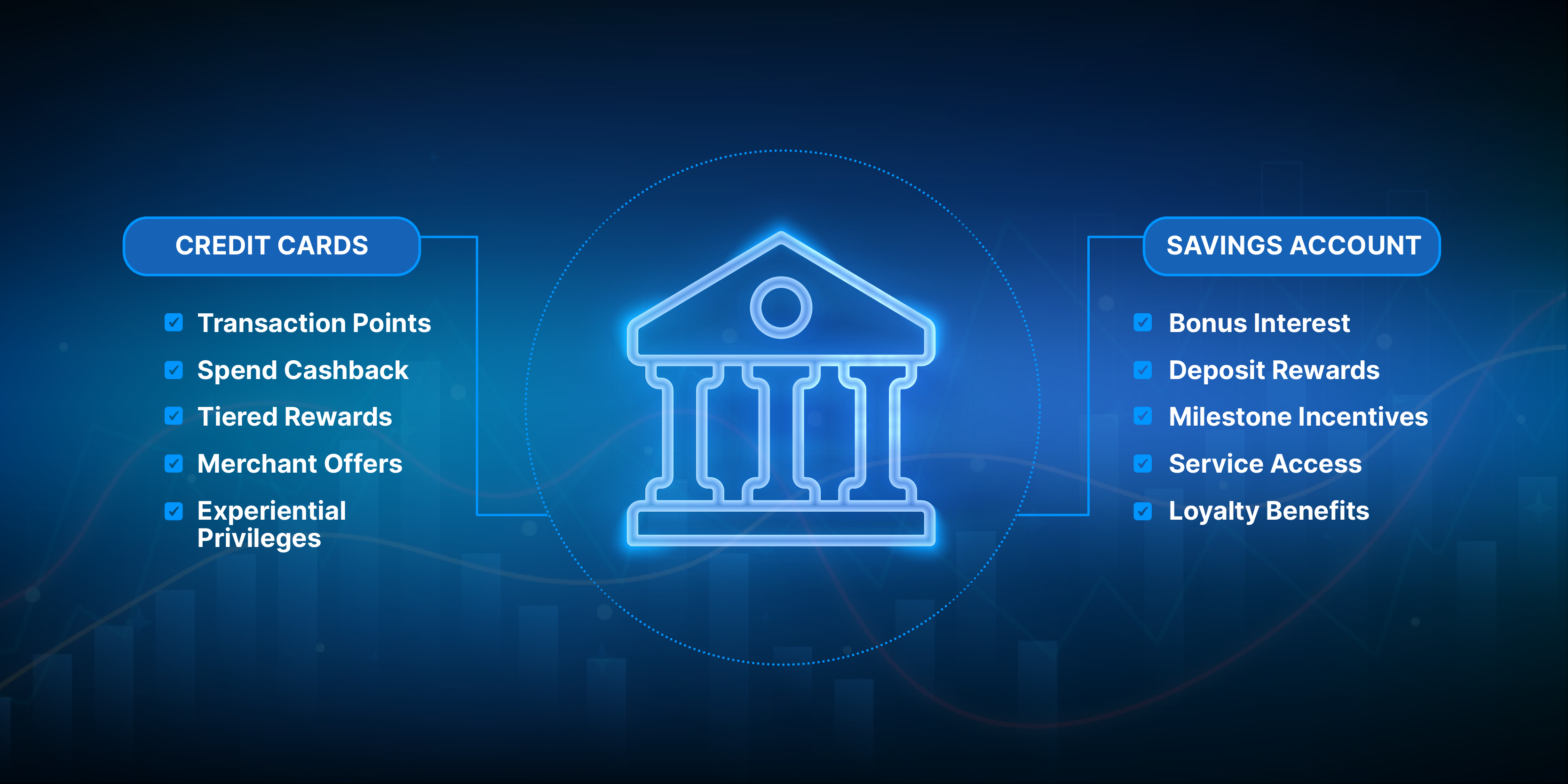
Credit card loyalty programmes usually show faster engagement because they connect rewards to frequent, visible spending behaviour. Customers understand the value exchange quickly: spend, earn and redeem. This makes credit cards well suited to points, milestones, category accelerators, travel rewards, dining rewards, cashback alternatives and tiered benefits.
Deloitte’s 2024 Consumer Loyalty Survey found that financial rewards, simplicity and ease of use remain the most important loyalty attributes, with 86% of respondents rating them important or very important. It also found that four out of five consumers value flexibility when earning and redeeming rewards. These findings explain why credit card programmes often perform well when the reward path is simple and redemption feels flexible.
Credit Card Loyalty Strengths
The limitation is margin control. If rewards become too generous or too generic, customers may chase benefits without becoming more loyal to the bank. The programme must reward profitable spend, not only higher transaction volume.
Why Do Savings Account Rewards Need a Different Loyalty Model?
Savings account rewards need a different model because savings behaviour is less transactional than card spending. Customers may not interact with a savings account daily in a way that feels reward-worthy. The loyalty objective is therefore not only frequency. It is activation, trust, digital usage, balance stability, product depth and long-term relationship value.
Bain’s retention research shows why relationship depth matters. Increasing customer retention by as little as 5% can increase profits by 25% to 95%. For banks, a savings account can become the foundation for salary credits, deposits, bill payments, investments, cards, loans and wealth relationships when loyalty design supports deeper engagement.
Savings Account Reward Use Cases
Savings rewards should avoid paying customers simply to hold money without a behavioural strategy. The stronger model rewards actions that make the account more active, useful and central to the customer relationship.
Is a Credit Card Loyalty Programme More Effective Than Savings Account Rewards?
A credit card loyalty programme is usually more effective for short-term engagement because spend creates frequent reward moments. Savings account rewards are usually more effective for relationship depth when they encourage activation, retention and multi-product behaviour. The right answer depends on the business objective.
McKinsey’s banking personalisation research states that banks need more than analytics. They need an operating ecosystem that can use analytics well across decisioning, execution and measurement. This matters because both credit card and savings account loyalty programmes need segment-level journeys rather than broad campaign blasts.
Credit Cards vs Savings Accounts: Loyalty Comparison
A bank should not treat one model as universally better. Credit card programmes build spend engagement. Savings account rewards build relationship engagement. A mature loyalty strategy connects both.
What Drives Higher Engagement in Banking Loyalty Programmes?
Higher banking engagement comes from relevance, ease, personalisation, reward flexibility and measurable customer progression. Customers must understand what they earn, why it matters and how they can redeem it. A confusing reward journey weakens both credit card and savings account loyalty.
McKinsey reports that 71% of consumers expect personalised interactions, and 76% feel frustrated when companies fail to provide them. Banking loyalty must therefore move beyond static offers towards behaviour-led journeys that respond to customer stage, product use and intent.
The BANK Framework for Engagement
Deloitte’s loyalty research reinforces the importance of flexibility and ease of use. If customers earn rewards but cannot redeem them easily, the programme loses value at the exact moment loyalty should become tangible.
The Reward Store’s integrated storefront helps BFSI brands support varied customer motivations through gift cards from 5,000+ brands, flight bookings, hotel bookings, dining, golf, sports, experiences, merchandise, bus bookings and concierge services.
How Should Banks Design Credit Card Loyalty Journeys?
Banks should design credit card loyalty journeys around spend quality, not spend volume alone. A customer who increases spend in profitable categories, uses the card repeatedly and redeems points meaningfully is more valuable than a customer who only responds to one-off offers.
Credit Card Loyalty Journey Design
McKinsey’s loyalty guidance notes that loyalty programmes need core earn and burn functionality with personalisation at scale. This is especially relevant for credit cards because customers compare value across products and providers quickly.
Credit card loyalty should avoid blanket rewards for all spend. Better results come from behaviour-led incentives linked to activation, frequency, preferred categories, profitability and retention.
How Should Banks Design Savings Account Reward Journeys?
Banks should design savings account reward journeys around relationship behaviour. Savings accounts can support loyalty when they become the customer’s primary banking relationship, not merely a dormant balance holder.
Savings Account Reward Journey Design
Bain’s retention economics support this model because relationship-led banking value grows when customers stay longer and deepen their product usage.
Savings account rewards should also protect trust. The bank should communicate eligibility, reward value and terms clearly. If customers feel the reward is conditional in a confusing way, the programme can damage confidence rather than build loyalty.
How Can Rekyndl Support Credit Card and Savings Account Loyalty?
Rekyndl helps BFSI and fintech brands create loyalty journeys across credit cards, savings accounts, wallets, payments and digital banking use cases. Through Rekyndl for Financial Services and Fintech, marketing teams can automate behaviour-led campaigns, segment customers and connect reward journeys to redemption analytics.
Rekyndl can support:
- Credit card activation rewards.
- Spend milestone campaigns.
- Category-based earn accelerators.
- Savings account activation journeys.
- Balance milestone rewards.
- Digital banking adoption campaigns.
- Dormant customer reactivation.
- Points balance and redemption reminders.
- Cross-sell and relationship-depth journeys.
The advantage is orchestration. Instead of running separate product campaigns, banks can connect credit card spend, savings account activity, redemption behaviour and customer lifecycle into a measurable loyalty system.
What Metrics Should Marketing Leaders Track?
Marketing leaders should track different metrics for credit card loyalty and savings account rewards. A single loyalty dashboard can hide performance differences between spend-led and relationship-led products.
Banking Loyalty Measurement Guide
Deloitte’s loyalty research shows that customers value flexibility, simplicity and ease of use. These expectations should shape measurement because low redemption or poor repeat usage may show that the programme is too hard to understand or not valuable enough.
The strongest approach compares rewarded customers with similar non-rewarded customers. This shows whether loyalty journeys create incremental behaviour or simply reward activity that would have happened anyway.
Frequently Asked Questions
Is a credit card loyalty programme more effective than savings account rewards?
A credit card loyalty programme is usually more effective for fast engagement because customers earn rewards through frequent spending. Savings account rewards are more effective for relationship depth when they encourage account activation, balance stability, digital adoption and product holding.
What drives higher engagement in banking loyalty programmes?
Higher engagement comes from personalisation, simple earn and burn rules, flexible redemption, timely triggers and rewards linked to meaningful customer behaviour. McKinsey’s banking personalisation research shows that banks need an operating ecosystem that can turn analytics into execution and measurement.
Why do savings account rewards need different mechanics?
Savings accounts are relationship products, not pure transaction products. Rewards should therefore encourage activation, recurring credit, digital banking usage, balance milestones, product depth and long-term retention.
How should banks measure credit card loyalty success?
Banks should measure activation, repeat transaction rate, category spend uplift, monthly active cardholders, redemption rate, spend after redemption, churn reduction and customer lifetime value. The strongest proof comes from comparing rewarded customers with similar non-rewarded customers.
Can Rekyndl support both credit card and savings account loyalty journeys?
Yes. Rekyndl supports BFSI and fintech loyalty journeys across credit cards, savings accounts, payments and customer lifecycle campaigns. It helps marketing teams automate triggers, manage reward journeys and analyse redemption behaviour.
When should a bank connect credit card and savings account rewards?
A bank should connect both when it wants to deepen the customer relationship across products. For example, a savings account customer can receive activation rewards, then credit card spend rewards, then tier or redemption benefits based on broader relationship value.
Conclusion
Credit card loyalty programmes and savings account rewards serve different banking objectives. Credit cards create faster engagement through spend-linked earning and frequent redemption moments. Savings accounts build deeper relationship value through activation, digital adoption, balance behaviour and product holding. Deloitte, McKinsey and Bain all point to the same lesson: banking loyalty works when relevance, simplicity, flexibility and retention economics align.
The next phase of BFSI loyalty will connect products into customer-level journeys rather than isolated campaigns. Marketing leaders who build that connected model will create stronger engagement and more profitable customer relationships.
Ready to build loyalty journeys across credit cards, savings accounts and digital banking behaviour?
Explore how Rekyndl helps BFSI and fintech brands automate engagement, personalise rewards and measure loyalty performance.
Explore Rekyndl for BFSI and Fintech Loyalty
Sign up for our newsletter for trending top content!


