
How Do Leaderboards Influence Performance in Incentive Programmes?

Sign up for our newsletter for trending top content!
Properly designed incentive programmes improve performance by an average of 22 per cent, according to the Incentive Research Foundation. Leaderboards can contribute to that improvement by turning targets into visible rankings, giving participants immediate feedback, and showing how close they are to the next position or reward.
However, visibility alone does not guarantee better results. A leaderboard can motivate participants who see a realistic opportunity to progress, but it can discourage those who remain far behind the leaders. It may also direct attention towards the wrong activities when Sales Leaders choose incomplete or easily manipulated metrics.
This article explains how leaderboards influence sales behaviour, what makes an incentive leaderboard effective, and when Sales Leaders should combine rankings with tiers, challenges, team goals, and meaningful rewards.
Why Do Leaderboards Motivate Sales Teams?
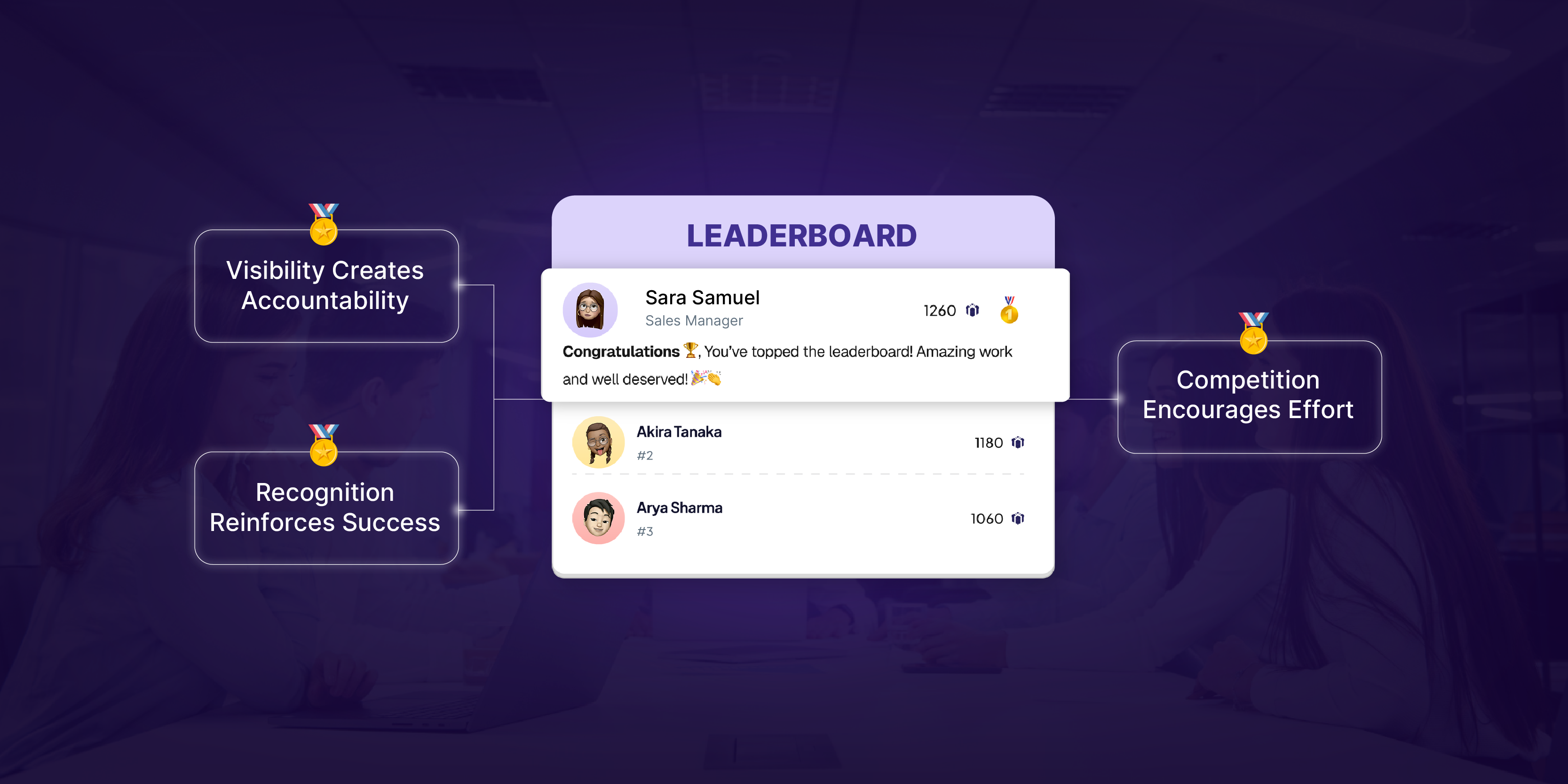
Leaderboards motivate sales teams by converting performance data into an immediate social comparison. Participants can see who leads, where they stand, and what improvement they need to reach the next position.
Gallup explains that employees with a strong competitive orientation respond positively to rankings, transparent performance data, and clearly defined measures of success. However, Gallup also emphasises that competition does not motivate every employee in the same way. Sales Leaders should therefore treat the leaderboard as one motivational element, not as the entire incentive strategy.
A leaderboard can influence behaviour through four mechanisms:
Progress Becomes Visible
Participants do not need to wait for a monthly review or final campaign result. Frequent updates help them connect current activity with programme progress.
Goals Become More Concrete
A target such as “increase strategic product sales” may feel broad. A leaderboard based on verified strategic product revenue shows the exact measure and the participant’s current position.
Competition Creates Urgency
Small gaps between positions can encourage participants to complete follow ups, progress qualified opportunities, or focus on time sensitive targets.
Achievement Receives Recognition
A high ranking creates visible status before the programme distributes the final reward. This recognition can reinforce effort, particularly among participants who value competition.
McKinsey identifies shared dashboards, real time progress reporting, and gamification as useful tools for strengthening competition and making sales transformation more immediate. It also recommends personalising goals by seller, manager, or region rather than applying one undifferentiated target.
Does Leaderboard Visibility Improve Performance?
Leaderboard visibility can improve performance when participants trust the data, understand the metric, and believe they can influence their position. It gives salespeople faster feedback than retrospective reports and makes performance gaps easier to identify.
McKinsey recommends using digital tools to demonstrate progress, communicate real time insights, and show individual contributions towards a common goal. This type of visibility can make a commercial priority feel more immediate and actionable.
Visibility becomes less effective when a leaderboard displays only the top performers. A participant ranked fiftieth may learn nothing useful from seeing the top five, particularly when the performance gap appears impossible to close.
Research into leaderboard design also shows that results depend on how organisations present relative position. A study involving more than 4,500 participants found that different leaderboard formats produced different performance effects, challenging the assumption that every leaderboard automatically improves results.
Sales Leaders should distinguish between three forms of visibility:
The most useful leaderboard does not merely identify the winner. It shows each participant a credible next step.
What Makes a Good Incentive Leaderboard?
A good incentive leaderboard uses clear, controllable, balanced, and verifiable performance measures. It should help participants decide what to do next rather than simply reporting who has already won.
The Incentive Research Foundation states that effective goals must be meaningful, measurable, and movable. Participants should consider the target fair, understand how the organisation measures it, and have enough control to influence the result.
Sales Leaders can apply the SCORE framework when designing a leaderboard:
S: Specific Metric
Choose a measure that reflects the commercial objective. Examples include verified revenue, gross margin, strategic product sales, qualified opportunities, activated partners, or conversion rate.
C: Controllable by Participants
McKinsey advises organisations to avoid measures that sit outside the seller’s control. A ranking based on total revenue may become unfair when territories vary substantially in size, maturity, or market opportunity.
O: Observable in Time
Update the leaderboard frequently enough to influence behaviour. Delayed data weakens the link between action and progress.
R: Relevant to Business Value
The leaderboard should promote profitable behaviour, not activity for its own sake. Ranking call volume without considering opportunity quality can encourage unproductive actions.
E: Equitable Across Participants
Segment leaderboards by role, geography, partner type, tenure, or opportunity level when participants do not compete under comparable conditions.
The Reward Store’s guide to goal setting in incentive programmes explains how precise and attainable goals improve programme clarity. Sales Leaders should also document calculation rules, data sources, tie breaking methods, and dispute processes before launch.
How Can Poor Leaderboard Design Reduce Sales Performance?
Leaderboards can reduce performance when they make success appear unattainable, create perceptions of unfairness, or encourage participants to maximise the displayed metric at the expense of the broader commercial objective.
The Incentive Research Foundation found that participants may consider competitive tournament structures less fair than quota or individual achievement models. Its research also suggests that competition alone does not provide the same sense of control as a structure in which each participant can earn by reaching a defined threshold.
Poor design creates four common risks:
Lower Ranked Participants Disengage
A large and persistent gap between the leaders and the rest of the field can convince participants that extra effort will not change the outcome. A tiered programme or relative position leaderboard can provide more attainable progress.
Participants Game the Metric
Salespeople naturally prioritise the activity that changes their ranking. If the leaderboard rewards revenue without considering margin, returns, customer quality, or payment collection, it may encourage commercially weak sales.
Competition Damages Collaboration
An individual ranking can discourage lead sharing and joint selling when several people contribute to the same opportunity. The Incentive Research Foundation reports that team based rewards can produce better results where small groups perform highly interdependent work.
Established Leaders Receive Predictable Rewards
A leaderboard may simply confirm an existing hierarchy when the same high performers begin with larger territories, stronger pipelines, or more mature accounts.
The Reward Store’s article on why rewarding only top performers is risky explains why programmes need credible earning routes beyond the highest ranking positions.
Which Leaderboard Structure Should Sales Leaders Choose?
The right leaderboard structure depends on the campaign objective, participant group, performance cycle, and degree of collaboration required.
The Incentive Research Foundation reports that top performing organisations use more flexible qualification thresholds and allow participants to earn from an initial sale or minimum threshold more often than comparator organisations. This supports a blended design in which participants earn through achievement tiers while the leaderboard adds competition and recognition.
Sales Leaders should also match the measurement period to the sales cycle. A weekly ranking may suit high frequency transactions, while complex business sales may require monthly or quarterly measures based on qualified pipeline, stage progression, and revenue.
A leaderboard should never force every commercial objective into one score. Where several behaviours matter, use separate rankings or a transparent points model that assigns an appropriate weight to each measure.
How Should Leaderboards Work With Rewards, Challenges, and Tiers?
Leaderboards work best as part of a broader gamification structure. Rankings provide visibility and social comparison, while points, tiers, challenges, and rewards create several ways to participate and progress.
The Incentive Research Foundation describes gamification as a natural extension of performance improvement and incentive design. Game mechanics can support sales activity, customer relationship management adoption, learning, and other behaviours when organisations link them to specific business results.
A balanced structure may include:
- Points: Participants earn points for verified actions, such as qualified opportunities, completed training, strategic sales, or account activation.
- Tiers: Participants progress through defined achievement levels without needing to outperform every colleague.
- Leaderboards: Rankings create visible competition within comparable participant groups.
- Challenges: Short campaigns focus attention on a product, market, behaviour, or sales period.
- Rewards: Participants receive relevant value when they reach thresholds, win challenges, or complete milestones.
This design protects the motivational value of competition while giving more participants a credible earning opportunity.
Paytives gamification features include real time leaderboards, milestone challenges, sprint contests, and time limited bonus events. Sales Leaders can combine these features with custom incentive rules, performance tracking, automated calculations, and global reward delivery.
Available reward categories can include gift cards from 5,000+ brands, flight bookings, hotel bookings, dining, merchandise, golf, sports, experiences, bus bookings, and concierge services.
How Can Sales Leaders Measure Leaderboard Effectiveness?
Sales Leaders should measure whether the leaderboard changes profitable behaviour, not simply whether participants view it.
The Incentive Research Foundation advises organisations to select, implement, and monitor incentives carefully. Its research shows that incentives increase performance when programme owners address the full set of motivational and operational conditions.
A practical measurement framework should include:
Sales Leaders should compare results with a historical baseline, previous campaign, matched group, or comparable territory where possible. They should also examine performance by participant segment. An overall revenue increase can conceal disengagement among new, mid-level, or smaller participants.
The Reward Store’s guide to transparency in incentive programmes explains why visible calculations, timely progress information, and clear programme rules support participant trust.
Frequently Asked Questions
How Do Leaderboards Motivate Sales Teams?
Leaderboards motivate sales teams by making performance visible and showing each participant’s position relative to peers or targets. They create urgency when the gap to the next position appears achievable. Gallup recommends transparent performance data and clearly defined measures for employees who respond strongly to competition.
What Makes a Good Incentive Leaderboard?
A good incentive leaderboard uses a clear business metric, reliable data, frequent updates, and fair comparison groups. Participants should understand how the organisation calculates rankings and have enough control to improve their position.
Does Leaderboard Visibility Improve Performance?
Visibility can improve performance by providing immediate feedback and making progress easier to understand. However, a top performer only leaderboard may discourage participants who cannot see an attainable route forwards, so larger programmes should consider relative rankings, tiers, or personal progress views.
Why Can Sales Leaderboards Demotivate Lower Performers?
Lower performers may disengage when the distance to a reward or leading position appears impossible to close. Sales Leaders can reduce this risk through segmented rankings, regular resets, improvement measures, and achievement tiers.
When Should a Sales Leaderboard Reset?
The reset period should match the sales cycle and campaign objective. Weekly resets can support short activity campaigns, while monthly or quarterly leaderboards suit longer sales processes. Frequent resets also give new and mid-level participants another opportunity to compete.
Can Paytives Run Gamified Sales and Channel Incentive Programmes?
Yes. Paytives supports real time leaderboards, milestone challenges, sprint contests, time limited bonus events, custom earning rules, and automated incentive calculations. Sales Leaders can use these features to create separate competitions for different partner types, regions, products, or performance tiers.
Conclusion
Leaderboards influence performance by making progress visible, competition immediate, and achievement recognisable. Their effectiveness depends on more than displaying a ranking. Sales Leaders need fair comparison groups, controllable metrics, timely data, attainable progress, and rewards connected to profitable behaviour. The strongest programmes combine leaderboards with tiers, challenges, team measures, and personal targets so that competition motivates more than the established leaders. As sales ecosystems become more data driven, leaderboard design will increasingly determine whether gamification creates sustained growth or short lived activity.
Sign up for our newsletter for trending top content!


