
How Employee Recognition Reduces BPO Attrition: A Data-Led Framework for Operations Leaders

Sign up for our newsletter for trending top content!
Introduction
BPO attrition continues to pressure operations teams despite rising compensation budgets. Industry studies from NASSCOM and Mercer consistently show that annual attrition in customer operations and consulting support functions often remains above 30 percent in high volume environments.
Meanwhile, Gallup reports that employees who do not feel recognised are twice as likely to say they will quit within the next year.
For HR leaders, this creates a costly cycle. Recruitment expenses rise, training investments reset, service quality suffers, and SLA performance becomes harder to maintain.
This article explores why salary increases alone fail to reduce churn, where recognition gaps emerge across large BPO operations, and how structured recognition frameworks help predict and reduce attrition. It also outlines a practical 90 day rollout model designed specifically for HR and operations leaders managing scale.
Why BPO Attrition Remains Stubbornly High Despite Rising Salaries
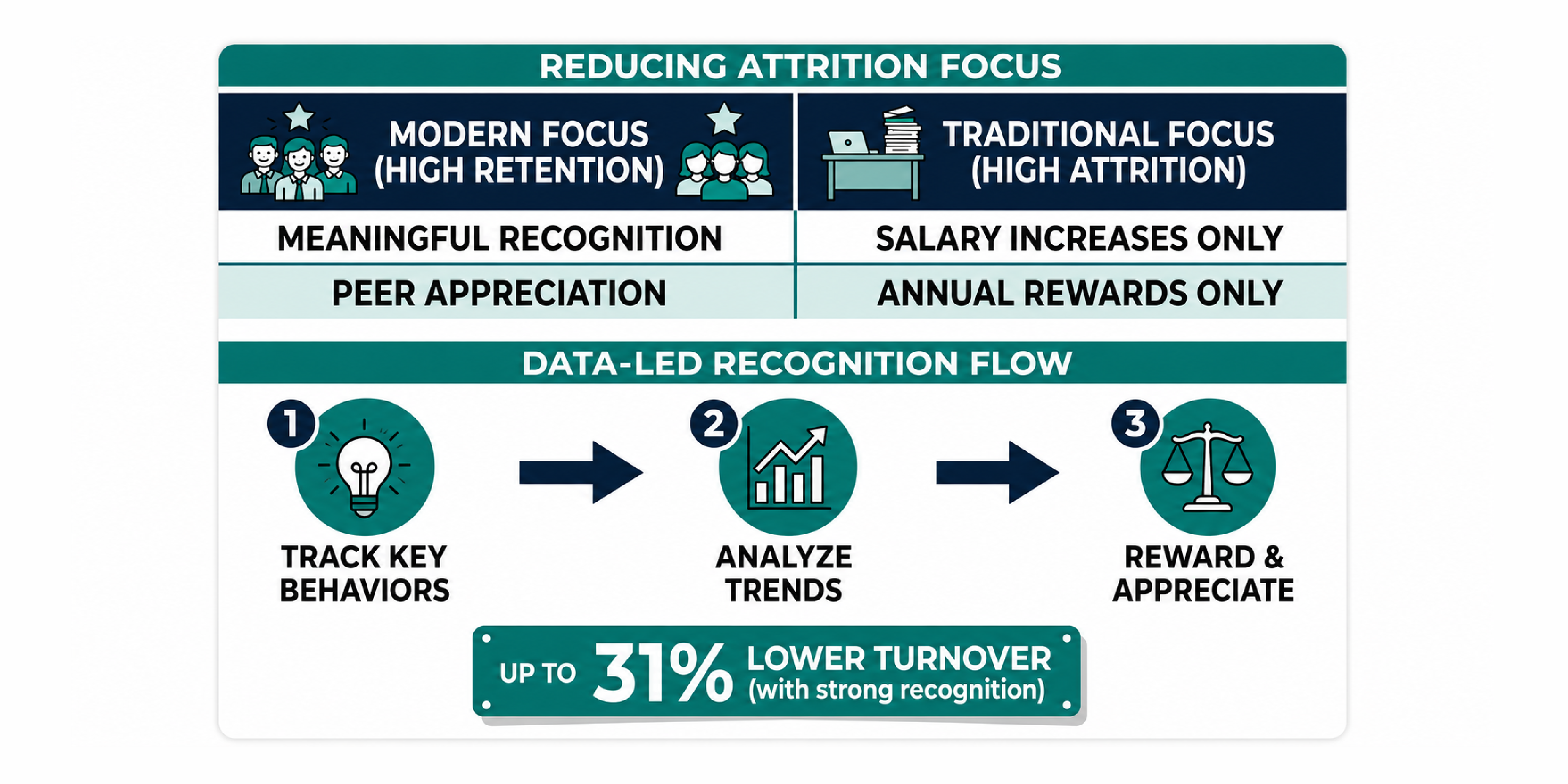
Salary growth has not solved the retention problem because compensation rarely addresses the daily experience of frontline employees.
Mercer research shows employees increasingly prioritise career growth, wellbeing, flexibility, and recognition alongside pay. Gallup further reports that employees who receive meaningful recognition are more engaged and significantly less likely to seek external opportunities.
BPO environments amplify this challenge because employees operate in high volume, metric driven systems where repetitive work, shift schedules, customer escalations, and SLA pressure create emotional fatigue.
The retention equation has shifted
Deloitte research found organisations with strong recognition cultures experience better engagement outcomes and stronger retention performance.
For BPO leaders, the issue becomes operational rather than cultural alone. Every resignation affects staffing ratios, customer experience metrics, onboarding costs, and delivery continuity.
Recognition therefore moves from an HR initiative to a workforce stability mechanism.
The Recognition Gap: What BPO Employees Say They Need vs What They Get
Employees consistently report that recognition matters, yet many organisations still deliver it inconsistently.
O.C. Tanner research found that employees who receive meaningful recognition demonstrate stronger commitment, higher belonging, and lower intent to leave. However, SHRM studies indicate many employees still feel undervalued at work.
This gap becomes visible on large BPO floors where recognition often depends entirely on manager bandwidth.
What employees want
BPO employees frequently seek:
• Immediate acknowledgement after difficult customer interactions.
• Visibility for process improvements.
• Recognition for collaboration.
• Appreciation for consistency, not only top performance.
What organisations often provide
• Quarterly awards only.
• Recognition limited to top performers.
• Delayed manager feedback.
• Incentives linked solely to output.
This creates invisible contributors.
Platforms such as ApplaudIQ address this challenge by introducing structured peer recognition through social recognition streams, milestone automation, leaderboards, and appreciation walls. Features such as peer to peer appreciation help distribute recognition across teams rather than concentrating it within management layers.
Gallup reports employees who receive recognition within seven days perform better and remain more engaged.
In high attrition operations, timing matters as much as reward value.
How Peer-to-Peer Recognition Changes the Dynamic on Large BPO Floors
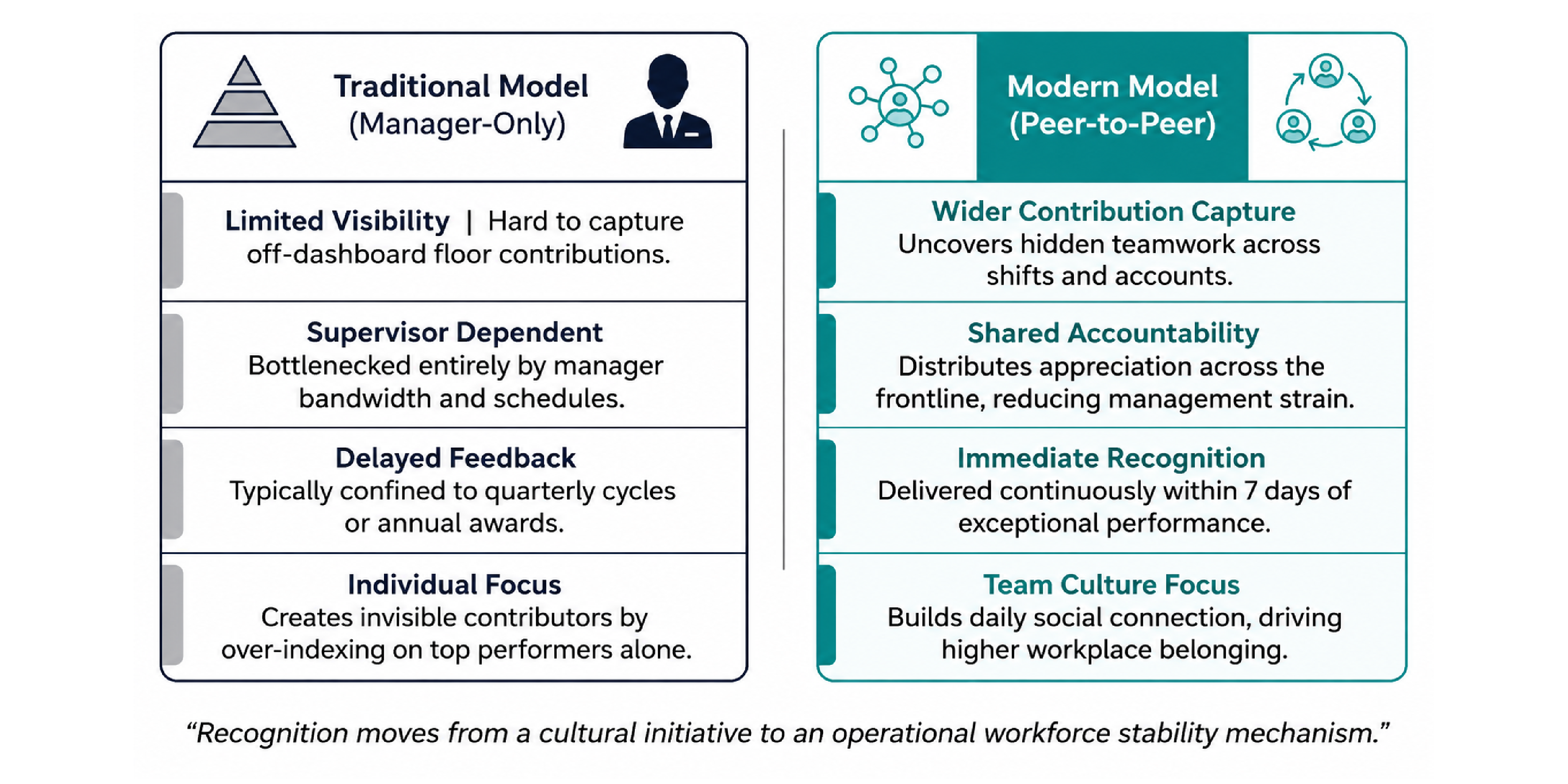
Large BPO operations often run teams across shifts, geographies, and client accounts. Managers cannot observe every contribution.
Peer recognition closes that visibility gap.
O.C. Tanner research found peer recognition increases belonging and creates stronger cultural connection because appreciation becomes continuous rather than hierarchical.
Traditional model versus peer recognition model
Consider a customer support floor handling escalation queues.
An employee who helps colleagues resolve difficult interactions may never appear in SLA dashboards. Yet peers observe this behaviour daily.
Recognition systems that enable employees to appreciate teamwork, knowledge sharing, coaching, and support uncover hidden contributors.
ApplaudIQ supports this through “Cheers”, Wall of Appreciation functionality, leaderboards, and integrations with collaboration tools so recognition occurs inside existing workflows.
McKinsey research notes that social connection remains a major retention factor in frontline environments.
Peer recognition strengthens precisely that connection.
Tying Recognition to SLA Performance: How to Make It Work Without Gaming
Many BPO leaders hesitate to link recognition with operational metrics because poorly designed systems encourage gaming.
Recognition must reward behaviour alongside outcomes.
Aberdeen Group research shows organisations that align recognition with strategic objectives achieve stronger performance results than those using ad hoc programmes.
A practical framework
For example:
Recognise outcomes: SLA consistency, quality adherence, attendance.
Recognise behaviours: mentoring, knowledge sharing, escalation support.
Recognise growth: certifications, cross skilling, coaching contributions.
Gartner research indicates employee experience programmes perform better when organisations measure both performance and behaviours.
Recognition technology should therefore support tiered rewards, approval flows, and analytics rather than operating as a simple points system.
This becomes particularly important across consulting support and multi account BPO environments.
The Early Warning System: Using Recognition Analytics to Predict Attrition Before It Happens
Most attrition interventions happen too late.
Exit interviews identify reasons after employees have already disengaged.
Recognition data creates earlier signals.
Gallup research shows disengagement indicators often appear months before resignation. Employees who stop participating, receive less feedback, or become socially disconnected show higher turnover risk.
Recognition analytics signals HR leaders should track
Recognition received trend
Declining recognition volume may indicate withdrawal.
Peer interaction frequency
Lower collaboration visibility often precedes disengagement.
Manager participation rates
Teams with weak manager recognition often show higher churn.
Reward redemption patterns
Reduced participation may indicate lower engagement.
Recognition platforms such as ApplaudIQ help HR teams analyse participation trends, recognition frequency, milestone completion, and manager activity.
Combined with HRMS integrations, organisations can identify risk segments earlier.
Forrester research notes employee experience analytics increasingly support proactive retention strategies.
The shift is significant.
Organisations no longer need to wait for resignations. They can identify engagement decline before attrition becomes visible.
What a 90 Day Recognition Programme Rollout Looks Like for a BPO Operation
HR leaders often delay recognition programmes because deployment appears complex.
A phased rollout reduces risk.
Days 1 to 30: Baseline and design
Objectives:
• Measure attrition hotspots.
• Identify recognition gaps.
• Define behaviours to reward.
• Align with operations leadership.
Inputs:
Attrition reports, SLA metrics, engagement surveys.
Days 31 to 60: Pilot launch
Actions:
• Introduce peer recognition.
• Launch manager recognition training.
• Enable milestone rewards.
• Create recognition categories.
Pilot teams:
Customer support pods, consulting delivery teams, shift groups.
Days 61 to 90: Analytics and optimisation
Track:
• Participation rates.
• Recognition frequency.
• Engagement trends.
• Attrition movement.
IRF research shows structured incentive programmes improve engagement outcomes when organisations actively monitor participation and results.
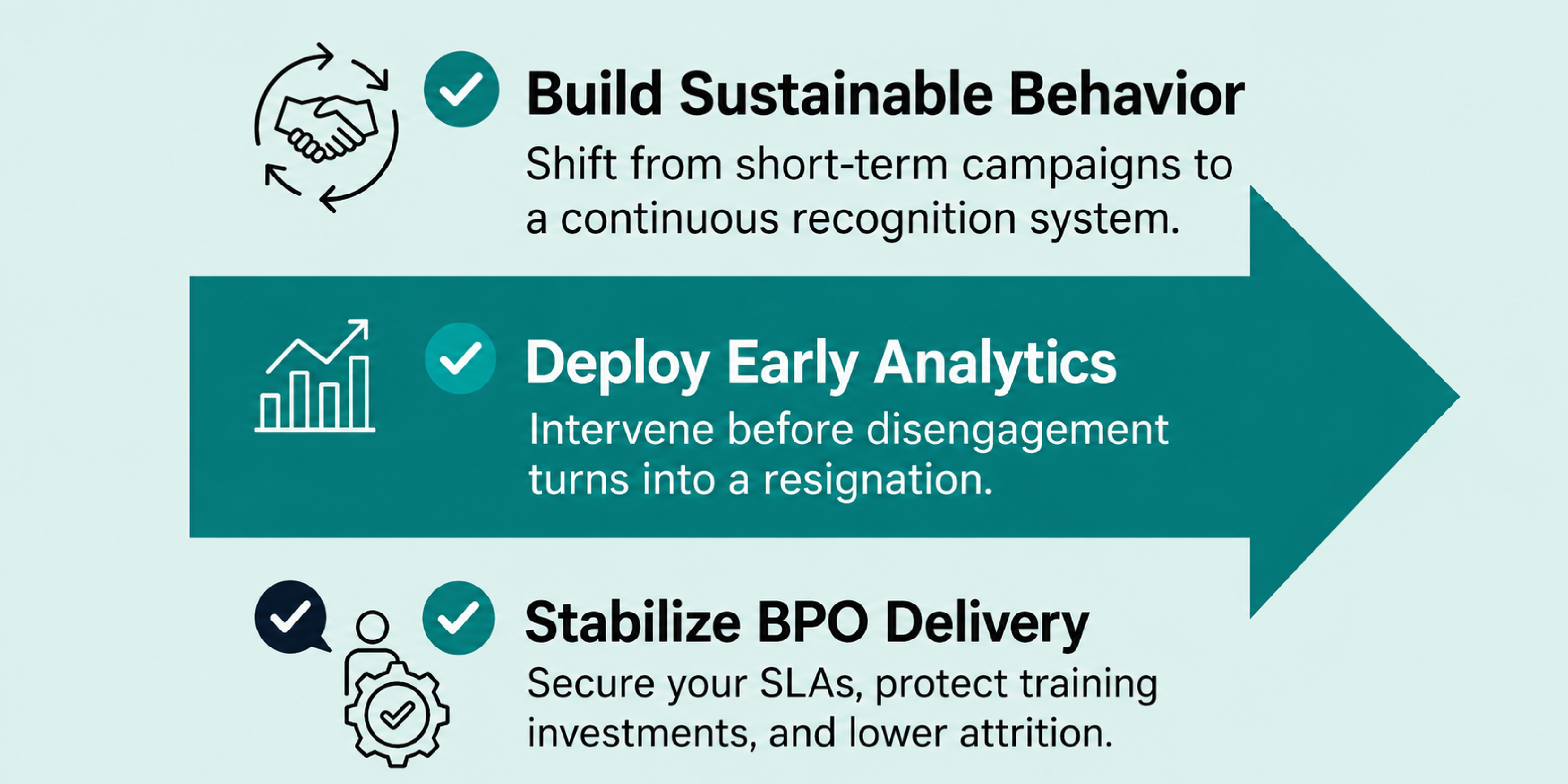
Recognition should operate as a continuous system rather than a campaign.
This creates sustainable behaviour change.
Frequently Asked Questions
What is the connection between employee recognition and BPO attrition?
Recognition improves engagement, belonging, and emotional connection. Gallup research shows employees who do not feel recognised are significantly more likely to leave. In BPO settings, where workload intensity remains high, frequent recognition helps reduce disengagement before resignation occurs.
How often should BPO organisations recognise employees?
Recognition should happen continuously rather than quarterly. Gallup suggests recognition within seven days delivers stronger impact. Peer recognition also increases visibility across large teams.
Can recognition improve SLA performance?
Yes. Recognition works best when organisations reward both outcomes and behaviours. Recognising collaboration, mentoring, and quality improvements supports performance without encouraging metric manipulation.
When should HR leaders introduce recognition analytics?
Organisations should introduce analytics early. Tracking recognition participation, manager activity, and peer interactions creates leading indicators for retention risk.
How does ApplaudIQ support BPO retention strategies?
ApplaudIQ supports peer recognition, milestone rewards, social appreciation, leaderboards, HRMS integration, and analytics dashboards. These capabilities help HR leaders build structured recognition programmes at scale.
Conclusion
Reducing BPO attrition requires more than compensation adjustments. Employees stay where they feel recognised, connected, and visible.
Structured recognition creates measurable retention signals while strengthening engagement and operational performance. The next phase for HR leaders will move beyond appreciation alone toward predictive recognition systems powered by analytics and workforce insights.
Recognition is increasingly becoming a retention infrastructure rather than an engagement initiative.
See how ApplaudIQ helps BPO operations reduce attrition through structured recognition programmes.
Explore the solution here: ApplaudIQ
Sign up for our newsletter for trending top content!


