
How to Automate Distributor Incentive Payouts and Eliminate Month-End Reconciliation

Sign up for our newsletter for trending top content!
Introduction
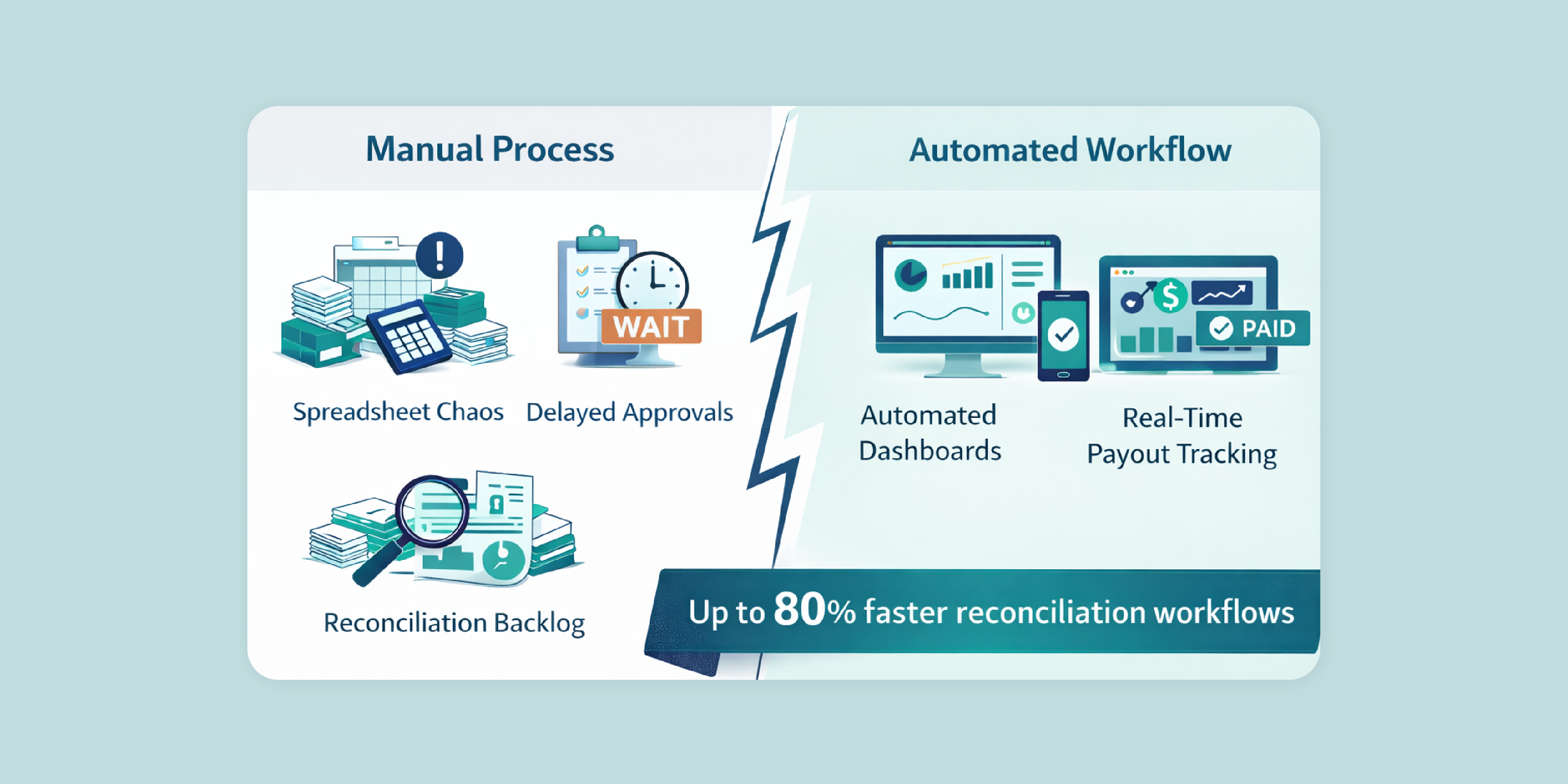
Channel incentive administration consumes more time than many sales leaders realise. Research from McKinsey & Company shows that organisations can automate up to 60 percent of sales operations activities, yet many channel teams still reconcile distributor incentives manually through spreadsheets and email chains. The result is delayed payouts, disputed calculations, and strained distributor relationships.
For consumer goods and retail organisations managing multi tier distribution networks, month end reconciliation often becomes a recurring operational bottleneck. Sales teams chase numbers. Finance teams validate calculations. Distributors wait for answers.
This article explains how to automate distributor incentive payouts, remove reconciliation friction, configure rules driven incentive structures, and create transparent earning visibility across channel ecosystems. It also outlines how sales organisations can move from manual processes to automated execution within six weeks.
Why Manual Commission Reconciliation Is Killing Your Channel Relationships
Distributor relationships depend on trust. Incentive disputes erode that trust faster than almost any operational issue.
Research from Forrester Research found that partner experience directly affects channel engagement and programme performance. Yet many consumer goods companies still calculate incentives through disconnected spreadsheets, sales exports, and manual approvals.
Month end typically follows this pattern:
- Sales exports distributor sales data.
- Finance validates performance against schemes.
- Managers adjust exceptions manually.
- Teams circulate payout sheets.
- Distributors raise disputes.
Every handoff creates risk.
A study by Gartner estimates that poor data quality costs organisations millions annually through operational inefficiencies. Incentive reconciliation amplifies this problem because payout calculations often combine targets, slabs, seasonal campaigns, bonuses, and regional variations.
For distributors, delayed visibility creates uncertainty:
Delayed payouts reduce motivation
The Incentive Research Foundation reports that timely incentive delivery significantly improves engagement and programme participation. Delayed rewards reduce behavioural impact.
Disputes increase administrative load
Sales leaders lose time resolving payout questions instead of driving market growth.
This is where platforms such as Paytives shift incentive management from reconciliation workflows to automated execution.
The Four Failure Modes of Spreadsheet-Based Incentive Management
Spreadsheet management works at small scale. Large distributor ecosystems expose its limits.
Research from Deloitte highlights spreadsheet dependency as a major operational risk factor because manual processes increase error probability as complexity rises.
1. Incentive rule explosion
Consumer goods organisations rarely run one incentive scheme.
They manage:
• Volume incentives
• Retail activation bonuses
• Territory campaigns
• Seasonal schemes
• Product mix accelerators
• Growth rewards
Manual calculation becomes unsustainable.
2. No real time earning visibility
Distributors wait until month end to understand earnings performance.
According to Bain & Company, transparency improves partner loyalty and retention outcomes.
3. Manual payout dependencies
Finance teams become operational bottlenecks.
4. No audit trail
Spreadsheet versions multiply. Historical changes disappear. Approvals remain fragmented.
Automated incentive systems eliminate these constraints through rule engines, live tracking, and integrated payout workflows.
What Automated Distributor Incentive Management Actually Looks Like
Automated incentive management replaces spreadsheets with rule based workflows connected directly to distributor performance.
Research from Aberdeen Group found that organisations using automated performance management achieve faster operational execution and stronger reporting visibility.
Modern distributor incentive automation includes five layers:
Incentive configuration
Sales leaders define schemes using rules:
• Revenue thresholds
• Product categories
• Territory goals
• Tier bonuses
• Growth targets
Performance ingestion
Sales systems feed transactions automatically.
CRM and ERP integrations reduce manual uploads.
Live calculations
The platform calculates earnings instantly as distributors achieve milestones.
Distributor visibility
Partners access dashboards showing:
• Current earnings
• Targets achieved
• Pending incentives
• Leaderboards
Automated payout execution
Paytives enables organisations to automate incentive calculations, performance tracking, and multi currency payouts across global distributor ecosystems while supporting multi tier structures and integrations.
For consumer goods leaders managing large retail channels, this creates operational continuity rather than month end firefighting.
Explore how this works in practice here: Paytives
How to Configure Incentive Rules That Calculate and Pay Without Human Intervention
Automation succeeds when organisations configure incentives correctly.
Research from Mercer shows that transparent and measurable incentive structures improve performance outcomes.
Step 1. Define measurable triggers
Avoid subjective conditions.
Good examples:
• Sell 10,000 units
• Achieve 15 percent quarterly growth
• Activate 50 retailers
• Reach product mix targets
Step 2. Create payout logic
Example structure:
Step 3. Add hierarchy logic
Consumer goods channels often include:
National distributor → Regional distributor → Retail partner
Paytives supports multi tier incentive structures so organisations can apply differentiated logic across partner layers.
Step 4. Automate payouts
The system calculates incentives continuously and releases payouts after approvals.
Research from McKinsey & company notes automation significantly reduces repetitive administrative effort.
Result:
Sales teams drive growth. Finance validates exceptions. Systems handle calculations.
What Changes When Distributors Can See Their Earnings in Real Time
Visibility changes behaviour.
The Incentive Research Foundation reports that incentive transparency increases programme participation and engagement.
Manual systems delay information.
Automated systems create immediate feedback loops.
Distributors can answer questions instantly:
• How close am I to target?
• Which products increase incentives?
• What payout have I already earned?
• Which campaign drives higher rewards?
Higher participation
Research from Gallup consistently links recognition visibility and performance feedback with stronger engagement outcomes.
Faster corrective action
Live dashboards allow distributors to adjust activity before period close.
Reduced disputes
Shared visibility removes reconciliation ambiguity.
Sales leaders also gain operational advantages:
• Live leaderboard tracking
• Territory comparisons
• Performance forecasting
• Campaign optimisation
The result is fewer payout conversations and more growth conversations.
Related reading: Employee Rewards and Recognition Solutions by ApplaudIQ
How to Migrate From Manual to Automated Incentives in 6 Weeks
Migration does not require a complete systems overhaul.
Research from NASSCOM indicates phased automation delivers faster adoption and lower operational disruption.
Week 1: Audit incentive schemes
Catalogue:
• Existing rules
• Distributor tiers
• Data sources
• Payout workflows
Week 2: Standardise calculations
Remove duplicate schemes and conflicting rules.
Week 3: Configure workflows
Map targets, approvals, payout triggers.
Week 4: Integrate systems
Connect CRM, ERP, and sales platforms.
Week 5: Pilot launch
Run selected distributor cohorts.
Week 6: Full rollout
Enable dashboards and automated payouts.
Paytives supports integrations with CRM and ERP environments while enabling global payout execution across more than 120 countries.
Sales leaders gain:
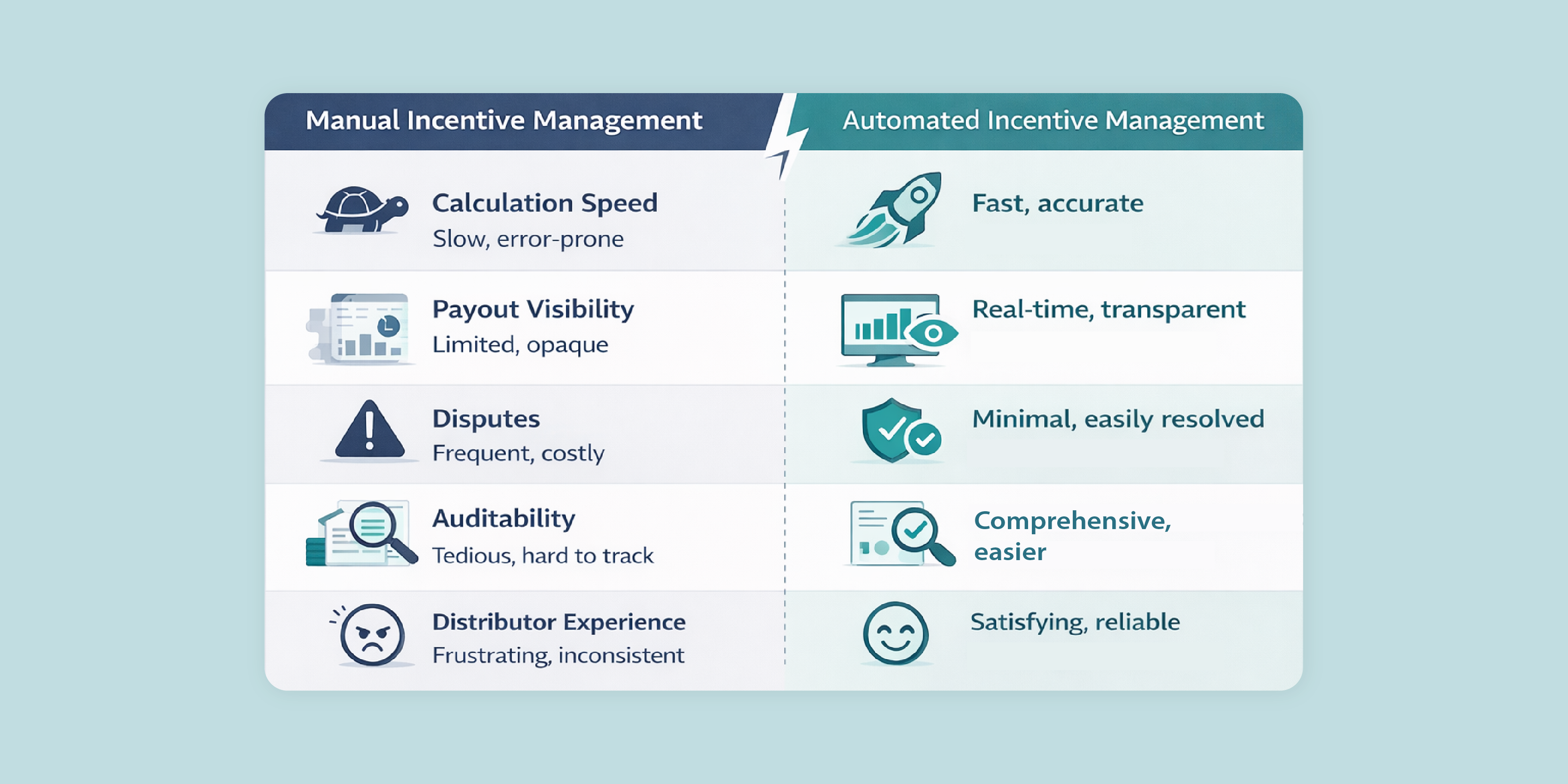
• Reduced reconciliation effort
• Faster payouts
• Better distributor engagement
• Audit visibility
Related insight: Consumer Loyalty Solutions by Rekyndl
Frequently Asked Questions
What is distributor incentive automation?
Distributor incentive automation uses software to calculate, track, approve, and pay channel incentives automatically. It removes spreadsheet reconciliation and manual calculations. Organisations gain faster payouts, fewer disputes, and better visibility.
How long does it take to automate distributor incentive payouts?
Most organisations can complete phased implementation within four to six weeks depending on integration complexity, distributor structure, and incentive rules. Starting with pilot cohorts often accelerates rollout.
Why do manual distributor payouts create reconciliation problems?
Manual processes rely on spreadsheets, email approvals, and multiple datasets. Formula errors, duplicate files, and delayed validation create disputes and operational delays.
Can Paytives support global distributor payouts?
Yes. Paytives supports multi currency payouts, multi tier channel structures, performance tracking, and automated incentive workflows across global distributor ecosystems.
When should consumer goods companies automate incentives?
Companies should automate when distributor networks expand, reconciliation time increases, or payout disputes become frequent. Early automation prevents operational complexity from scaling.
Conclusion
Manual incentive reconciliation creates hidden operational costs that extend beyond finance teams. It slows payouts, increases disputes, and weakens distributor confidence.
Automated distributor incentive management shifts organisations from reactive reconciliation to real time execution. As channel ecosystems grow, automation will increasingly become a competitive requirement rather than an efficiency project.

Stop the month end reconciliation scramble. See how Paytives automates distributor payouts:
Paytives Overview
Sign up for our newsletter for trending top content!


